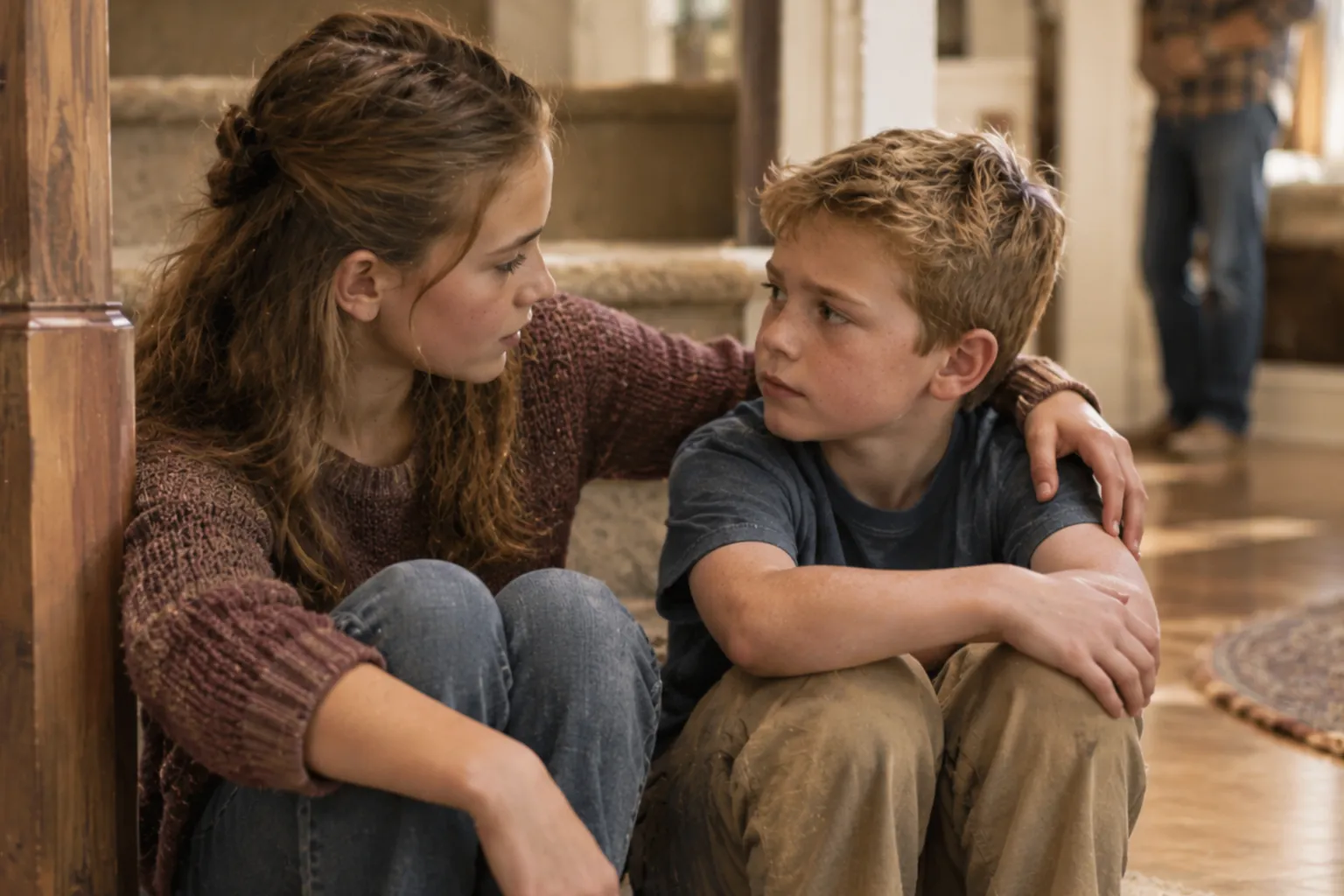
This is for parents who spend much of the day settling arguments over toys, seats and screens. It covers why refereeing keeps the fighting going, when to step in, a repair method children can learn, words to use, and how to make peace part of your family's ordinary rhythm.
Why does refereeing keep the fighting going?
When a parent decides every dispute, the children learn that conflict is solved by finding the judge. Each one brings the best case they can, and the goal becomes winning, not making peace. Every ruling leaves someone feeling it was unfair, which sets up the next round.
Refereeing also means you have to know what happened. Usually you don't. You arrive halfway through, hear two completely different stories, and make your best guess. The children know you're guessing.
Some conflict between siblings is normal and even useful. It's where children first practise sharing, standing up for themselves, and making things right. The goal isn't a home with no arguments. It's a home where children slowly learn to settle arguments well.
Conflict is normal. Repair is the skill.
When should you step in, and when should you stay out?
Step in straight away when someone may get hurt, when one child is much older or stronger and using that, or when the words have turned cruel. Safety comes first, always.
For ordinary squabbles, try waiting a moment. Many small arguments resolve on their own if no one rushes in. If it's escalating, come close without taking sides. Your calm presence often lowers the temperature before you say anything.
Avoid "Who started it?" It invites a trial with no fair verdict. Try instead: "I can see you're both upset. Let's sort this out."
What repair method can children learn?
Children can learn a simple sequence that works for most everyday conflicts. Teach it as a family, and use the same words every time so it becomes familiar.
- Calm down first. No one solves a problem while they're furious. A few deep breaths, a glass of water, a few minutes apart in different rooms. Be clear this isn't a punishment, just a pause.
- Each tells their side. One talks, the other listens without interrupting. Then they swap. Younger children can tell it to you, while the other listens.
- Each says what they need. "I need a turn." "I need you to ask before you take my things." Needs are easier to solve than accusations.
- Find a fix together. Take turns, share, swap, set a timer, find something else. Let the children suggest ideas first. Their solutions are often better than yours, and they're far more likely to keep them.
- Repair. An apology that names what happened, and a small act of kindness to put things right.
At first you'll guide each step closely. Over months, you'll say less and less. Eventually you'll hear an older child say to a younger one, "Let's calm down first," and you'll know it's working.
What words help in the moment?
Short, neutral phrases keep you out of the judge's chair. A few that many families find helpful:
- "I'm not here to decide who's right. I'm here to help you two work it out."
- "What happened, from your side? Your sister will listen, then it's her turn."
- "What do you need right now?"
- "What could you two try that would work for both of you?"
- "How can you make this right?"
Teach a real apology, not a forced one. "Sorry" muttered at the floor teaches little. A fuller apology sounds like: "I'm sorry I knocked over your tower. That wasn't kind. Can I help you build it again?" It names the harm, owns it, and offers repair.
A father of three young children found that one sentence changed his evenings: "You two have a problem. I trust you to solve it, and I'm right here if you get stuck." He sat nearby with a book. More often than not, they solved it.
How do you practise when things are calm?
Children can't learn a new skill in the middle of a fight, any more than adults can. Practise when everyone is calm.
Role-play common problems at the dinner table or during a family meeting. One child wants the swing, the other won't get off. Act it out, then walk through the steps. Let the children play the parent. They usually enjoy it, and it shows you what they've understood.
Talk about the patterns too. If the same argument keeps coming back, over the front seat, the remote or bath time, treat it as an issue for the whole family to solve. Set a fair rule together, such as taking turns by day of the week. A recurring fight is usually a problem with the setup, not with the children.
Spend time with each child alone. A great deal of sibling conflict is really competition for a parent's attention. A short, regular one-on-one time with each child, even a walk or a bedtime chat, often reduces the fighting more than any rule.
How do you build a home where siblings become friends?
Peace isn't just the absence of fighting. It grows from shared experiences that bind brothers and sisters together.
Give them work to do side by side. Shared stewardships, like washing the car together or planning a meal for the family, teach cooperation in a way no lecture can.
Create traditions that belong to them. A sibling movie night. A secret handshake. A yearly outing that's just for the children. A mother of four started a weekly "sibling breakfast" on Saturday mornings, where the children cooked pancakes together while she stayed out of the kitchen. It became one of their favorite times of the week.
And celebrate the repairs. When you see children work something out on their own, notice it out loud. "You two solved that yourselves. That was kind and wise." What a family celebrates, it tends to repeat.
Where Smarkle fits
Smarkle is a calm, private space for a family's shared vision, its rhythms and the issues it talks through. A recurring sibling argument can become an issue you raise and solve together at a family meeting, and one-on-one time with each child can become a rhythm you keep on purpose. Issues are normal and manageable, and talking about them openly is how children learn peace.