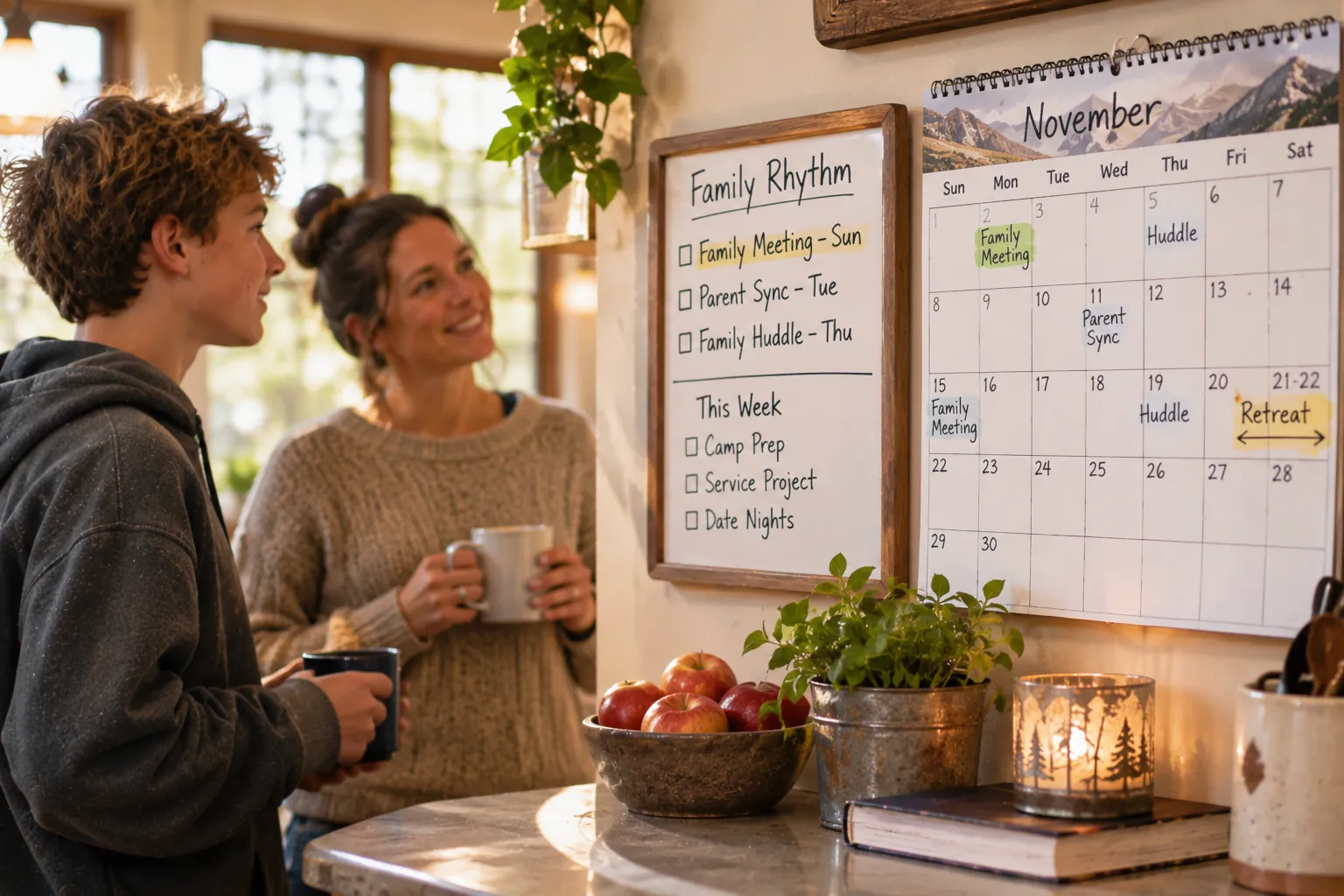
This is for families who have written something true about who they want to be and then watched it sit on the fridge, admired and unused. It covers how to read your vision for what it asks of you, how to choose one rhythm, how to protect it when the week fights back, and how to tell whether it is working.
Why does a vision fade after we write it?
A vision fades for a simple reason: nothing in the week depends on it. You wrote a paragraph about being a home where everyone is known. You chose a few values, maybe kindness, honesty and hard work. You found a maxim you liked. Then Monday came, and Monday was decided by the school run, the inbox and whatever was loudest.
That is not a failure of the vision. It is a missing bridge. Words describe a direction. Rhythms are how a family actually walks it. A vision that never reaches the calendar stays a wish, however beautifully it is phrased.
The good news is that the bridge does not need to be large. Most families need one rhythm to start, not a new system.
How do we find what our vision is asking of us?
Sit down with your vision, your values and your maxim, and read each line slowly. After each one, ask: if this were true of us, what would someone see us doing in an ordinary week?
Take a sample family whose paragraph says they want a home where everyone is known, everyone helps and everyone is welcome back. Read line by line, it becomes concrete:
- Everyone is known. Someone would see us talking, unhurried, at least once a week. Not logistics, but real conversation.
- Everyone helps. Someone would see children working beside adults, not just being handed chores.
- Everyone is welcome back. Someone would see the door open: a grandparent at the table, a friend staying for supper.
Each of those could become a rhythm. You are not going to start all three. Write them down anyway, because the list becomes your next season's options.
Then ask a sharper question: which of these, if we did it faithfully for a year, would change the most? Usually one answer stands out. That is your rhythm.
How do we choose the one rhythm to start with?
Good first rhythms share a few qualities. Use them as a filter.
- It sits on time you already have. Sunday dinner, the drive to school, Saturday morning. A rhythm that needs a new hour every week rarely survives.
- It is small enough for a hard week. If it only works when everyone is rested and cheerful, it will not last. Twenty minutes kept is better than two hours planned.
- It clearly serves the vision. You should be able to finish the sentence: we do this because we want to be a family that... If you cannot, choose again.
- Most of the family can take part. Not every rhythm needs everyone, but a first one benefits from shared ownership.
A father of four whose maxim was about work done well chose a single Saturday morning a month, working beside his children on a neighbor's yard. A grandmother living with her daughter's family, whose vision spoke of remembering where they came from, chose Sunday afternoon stories over tea. Neither rhythm was impressive. Both were obviously theirs.
One kept faithfully beats five that fade.
How do we protect it once it is on the calendar?
Choosing the rhythm is the easy part. Protecting it is where the vision becomes real.
Give it a fixed place. Same day, same time, same setting when you can. A rhythm you renegotiate every week is still a plan.
Decide in advance what it beats. Agree as a family what this rhythm outranks. Perhaps Sunday dinner outranks a casual invitation but not a grandparent's birthday. Making that call once, calmly, spares you a dozen tense calls later.
Say a good no out loud. When you turn something down to keep the rhythm, tell the children why. "We said no to the party because Sunday dinner is ours." That sentence teaches the vision better than any reading of it.
Name a keeper. Someone volunteers to carry it: to remember, to set the table, to send the reminder. Ownership that is chosen holds better than ownership assigned. Rotate it if that helps.
Expect missed weeks. Illness, travel and late games will happen. A missed week does not break a rhythm. Deciding that the missed week means you have failed does. Simply come back next time without a speech.
How do we connect the rhythm back to the vision?
A rhythm can drift into habit and lose its meaning. Keep the thread visible with small touches.
Mention the vision at the rhythm itself, briefly. At Sunday dinner, a parent might say, "We keep this because we want everyone here to be known." Once a month is plenty. More than that and it starts to sound like a lecture.
Use your weekly planning sitting to check it. In the Plan part, put the rhythm on the calendar first, before anything else claims the time. In the Celebrate part, notice when it went well. "That was a good dinner. Grandpa told the story about the flood again."
Look again each season. Ask together: is this still serving who we want to be? Has it become easy enough to run on its own? If yes, that is the moment to add a second rhythm from your list. If no, adjust it rather than abandon it. Shorter, earlier or in a different room often fixes more than you would expect.
And let rest count. A Sabbath kept as a day of rest, worship and unhurried time together is itself one of the strongest rhythms a vision can ask for. Many families find their vision is protected most simply by protecting that one day.
How do we know it is working?
You will not measure it with a score, and you should not try. Watch for quieter signs instead.
- Children start defending the rhythm themselves. "We can't, it's Sunday dinner."
- The vision's words show up in ordinary conversation without anyone reading them aloud.
- The rhythm needs less managing than it did at the start.
- Decisions get easier, because you know what you are protecting.
When those signs appear, the rhythm has become part of who you are. That is the whole goal: not a family that manages itself well, but a family whose habits carry what it cares about.
Where Smarkle fits
Smarkle is a calm, private space for your family's shared vision and the rhythms that carry it into the week. Your vision sits at the top of home, and each rhythm can be traced back to the line it serves. If you have not yet written yours, the vision journey walks you through it, and the vision part of the method explains the thinking behind it. For ideas on cadence, see the rhythms page.