This is for parents who want their children to feel they belong to something, not only to a household that shares a refrigerator. It is also for families who feel a little unanchored, perhaps after a move, a divorce or simply years of busyness. It covers where a sense of "we" comes from, the everyday habits that build it, and how to keep it warm rather than rigid.
Why does a family identity matter?
A child who knows who "we" are has somewhere to stand. When friends push toward something that does not fit, when school is hard, when the world feels large, a child can lean on a quiet certainty: we are people who tell the truth, who show up for each other, who work hard and laugh a lot.
That certainty does not make children narrow. It tends to make them steadier and more generous, because they are not scrambling to find a place to belong. The family has already given them one.
It also gives parents a way to talk about choices that is not about rules. "We don't do that" lands very differently from "because I said so." The first invites a child into something shared. The second only asks for obedience.
People like us do things like this.
Where does a sense of "we" actually come from?
Mostly from things that happen many times, not from things that are said once. The marketing writer Seth Godin put it simply in This Is Marketing: "People like us do things like this." Families work the same way. Identity is the sum of what people like us keep doing.
Three sources do most of the work:
- Repeated stories. The time the car broke down on the way to the coast. How a grandmother crossed an ocean with one suitcase. The night a toddler escaped the bath. Stories told often become the family's shared memory, and children learn who they are by hearing who came before.
- Shared work. Children who help cook, fix, plant and clean alongside parents learn that they are needed. Being needed is one of the strongest ways a child knows they belong.
- Small phrases. Every close family has sayings: "We finish what we start." "Nobody eats until everyone's served." "Leave it better than you found it." Short, repeated words become the family's voice in a child's head.
What everyday habits build it?
Most of what builds identity is ordinary. A few that families find worth keeping:
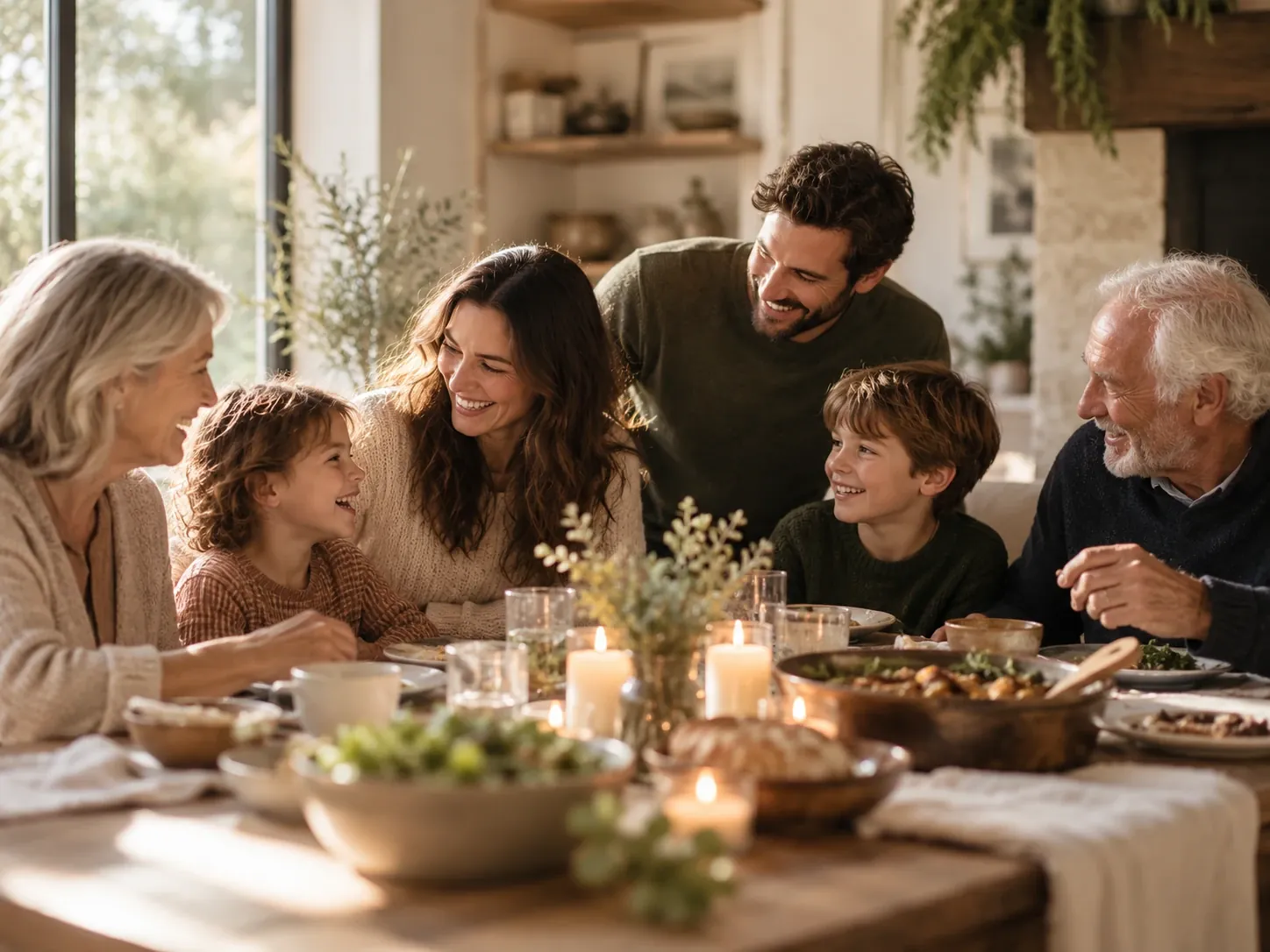
- A weekly meal with a question. Ask the same kind of question each time, such as "What was hard this week, and what did you do about it?" Over months, children learn what this family values hearing about.
- A family saying, chosen together. Ask your children what words describe your family at its best. Write two or three on a card and put it somewhere visible. Use them when praising, not only when correcting.
- A yearly tradition that belongs only to you. A first-snow breakfast, a summer camping trip, a birthday interview. It does not need to be grand. It needs to be yours and to come back every year. The traditions library has many ideas.
- A shared project. A garden, a fixed-up bicycle, a meal for a neighbor. Working on one thing together gives a family something to point at and say "we made that."
- Retelling the family story. At holidays, in the car, at bedtime. Let children ask for the same stories again. The repetition is the point.
How do we name what we stand for without lecturing?
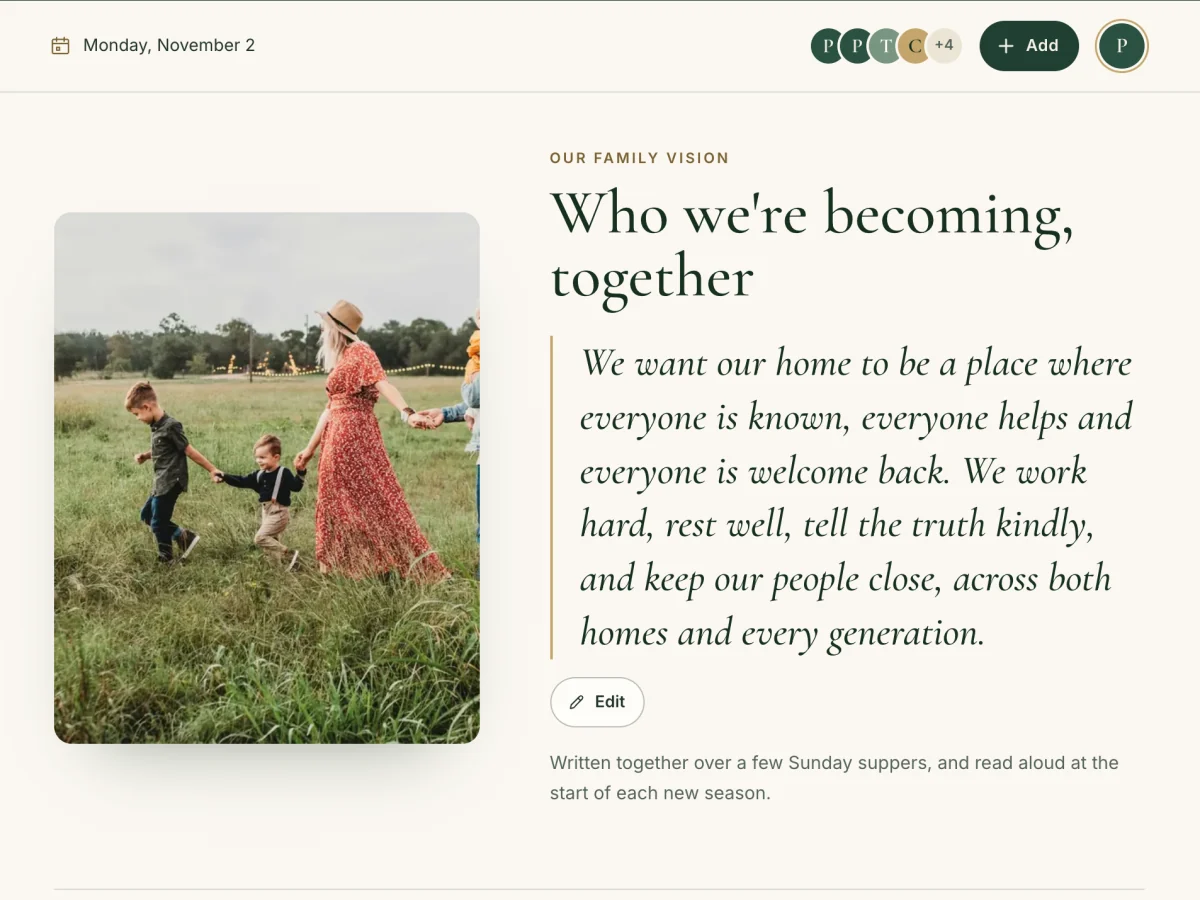
Some families write a short family vision: a few sentences about the kind of people they want to be and the life they want to build together. Done well, this is not a list of rules. It is a description of the family at its best, written so that everyone can recognize it.
A good way to start is to ask, over a relaxed meal:
- "When are we happiest as a family?"
- "What do you want people to say about our family?"
- "What do we do that other families might not?"
Write down what children say in their own words. A six-year-old's "We are kind to dogs" belongs on the page as much as a parent's careful sentence. You can read more about this in the vision part of the method.
When children later ask why your family does something differently from their friends' families, you have something warm to point to. There is a whole essay on answering that question: when a child asks why our family does things differently.
How do we keep identity from becoming pressure?
A family identity should feel like a home, not a uniform. A few cautions help:
- Leave room for each child. A family can share a direction without every child sharing the same dreams. The athletic family can hold a child who loves poetry.
- Avoid "we are better than them." Identity built on looking down on others is fragile and unkind. Describe who you are, not who you are not.
- Let it grow. The family you are with toddlers is not the family you will be with teenagers. Revisit your sayings and your vision every year or so.
- Never use belonging as a threat. "You're not acting like one of us" can wound deeply. Use the family's identity to invite, never to shame.
What if our family story includes pain?
Many do. Divorce, loss, addiction, estrangement. A family identity does not require a tidy history. Often the strongest stories are about getting through something hard together, or about a parent who chose to do things differently from how they were raised.
Tell these stories at an age-appropriate level, and focus on what the family learned and chose. "Your grandfather struggled, and we decided our home would be a safe place to tell the truth" gives a child something to stand on, without carrying weight that belongs to adults.