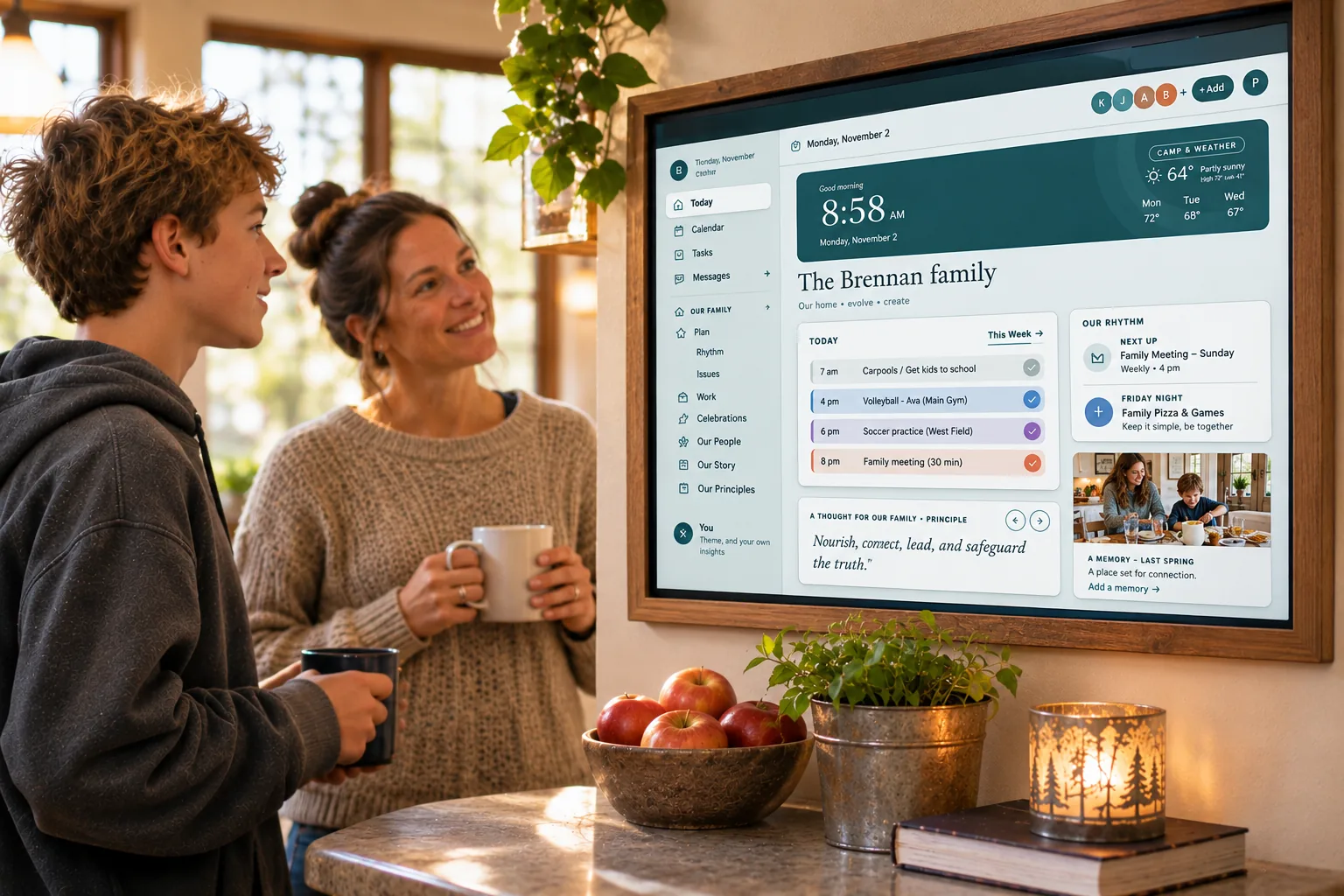
This is for parents who like the idea of family meetings but aren't sure how often to hold them, or who tried once and watched them fade. It covers what each layer of meeting is for, how to tell which ones your family actually needs, how the right cadence shifts as children grow, and how to keep meetings from taking over family life.
Why does frequency matter more than format?
A family meeting is a rhythm before it is anything else. Its value comes from showing up on a predictable beat, so everyone knows when there will be a moment to be heard. A brilliant meeting held once and never again does little. A plain meeting held every week for a year changes how a family talks.
The opposite mistake is just as real. Meeting too often turns family life into administration. Children start to dread "another meeting," and parents feel like managers. A family should never become an organization whose main activity is managing itself.
So the right question is not "what is the ideal schedule?" It is "what is the least we can do that reliably keeps us connected and coordinated?" That answer is different for every family, and it changes over time.
A family should never become an organization whose main activity is managing itself.
What is each kind of meeting for?
Think of the three layers as different distances: the week, the month and the year.
- The weekly pulse. Ten to twenty minutes, often on a Sunday evening. Its job is coordination and a little encouragement: who needs a ride where, what is coming up, one thing to celebrate from the week just past. It keeps small things from becoming surprises.
- The monthly check-in. Thirty minutes to an hour, perhaps on the first weekend of the month. Its job is depth: how is each person really doing? Is there an issue that keeps coming up? Is a rhythm working, or quietly slipping? This is where the family looks up from the calendar.
- The yearly look ahead. A longer, relaxed gathering, often around the new year, a birthday or the start of the school year. Its job is direction: what kind of family do we want to be this year? What do we want to learn, build or celebrate together? It is a good time to revisit a family vision.
Each layer does something the others can't. The weekly pulse is too short for deep conversation. The yearly look ahead is too far away to manage the days. The monthly check-in sits in between.
For what to actually cover inside each meeting, see how Smarkle approaches rhythms, which sets out the Plan, Work, Celebrate shape these gatherings follow.
Which ones does our family actually need?
Start with one. For most families, that is the weekly pulse, because its benefits show up immediately. Fewer missed pickups, fewer last-minute scrambles, and a regular moment to say something kind to each other.
Add the monthly check-in when you notice that weekly meetings feel rushed, or when the same concern keeps surfacing with no time to explore it. Add the yearly look ahead when you find yourselves wondering where the family is headed, or after a big change like a move or a new baby.
Some signs you might be meeting too often:
- Meetings regularly end with nothing to say.
- Children or a spouse treat them as a chore.
- The same items repeat every week without change.
Some signs you might need to meet more:
- Plans keep colliding at the last minute.
- Hurt feelings surface weeks after the event.
- One parent carries all the coordination in their head.
When something runs smoothly on its own, you can step back. That is success, not slippage.
How does the cadence change with the season of life?
Families move through seasons, and the meetings should move with them.
- Young children. Meetings are short and playful, mostly between parents. A father of toddlers might hold a weekly pulse with his wife after bedtime and a family "sticker meeting" of five minutes where each child gets a turn to talk.
- School-age children. The weekly pulse becomes a real family gathering. Children can run part of it, share a win, or help plan a weekend. A monthly check-in starts to make sense.
- Teenagers. Coordination gets heavier, so the weekly pulse often matters most. Teens may prefer shorter meetings and a real voice in the plans. A yearly look ahead can include their own hopes for the year.
- Blended and multi-home families. Weekly coordination may need to happen across households, sometimes just between adults. Keep the family gathering focused on the people under your roof on that day.
- Empty nest and extended family. Weekly meetings may become a monthly call with grown children, plus a yearly gathering with the wider family.
The schedule can change; the principle can't. Every season needs some steady moment to plan, check in and look ahead together.
How do we keep the rhythm going?
Most family meetings don't end with a decision to stop. They just fade after a busy month. A few habits protect the rhythm.
- Fix a time. Same day, same hour. A rhythm without a slot is just a good intention.
- Keep it short. End on time, or early. People come back to meetings that respect their evening.
- Always celebrate something. Even a hard week has one good moment. Naming it makes the meeting something people look forward to.
- Restart without guilt. If you miss a few weeks, just hold the next one. Say, "We fell off. Let's pick it up again."
Where Smarkle fits
Smarkle helps a family set its meeting rhythms on purpose and keep them gently in view: a weekly pulse, a monthly check-in, a yearly look ahead, or whatever mix fits this season. Notes, issues and celebrations from each gathering stay together in one calm, private place. You can see how it works or explore the sample family space.