







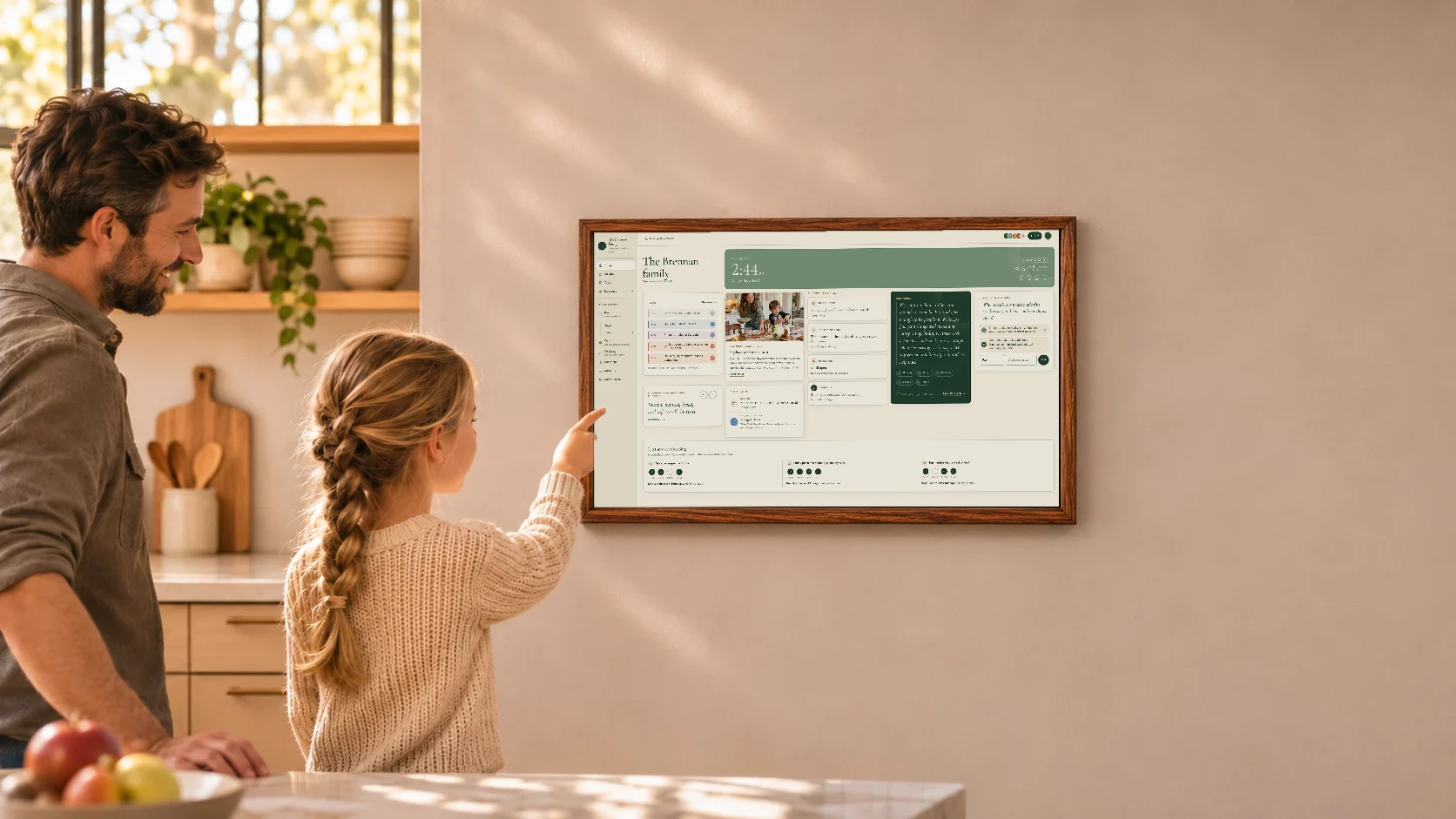
This is for families who have a screen in a central room and wonder whether it could do something better than sit dark or play recommendations. It covers why the default experience on most screens works against a family, what a good family display looks like, how to choose what to show, where to put it, and how to keep it private.
Why do most screens at home feel like they are selling?
Because many of them are. Smart TVs, streaming boxes and some photo frames are often designed to keep you watching or buying. When they are idle, they may show suggested programs, sponsored content or advertising on the home screen. Even ambient or art modes on some devices mix your photos with promoted content.
That matters more than it might seem. A screen in the kitchen or living room is seen dozens of times a day by every person in the house, including the youngest. Whatever it shows becomes part of the background of family life. A screen full of promotions teaches, quietly, that the center of the home is a place where things are sold.
The same screen could show something very different: the faces of the people who live there, the grandparents far away, last summer's camping trip, a child's painting of the dog.
What should a good family display show?
A good family display tends to show a small number of things, calmly:
- Your own photos, chosen and approved by a parent, changing slowly through the day.
- Children's art, photographed and shown with the same care as a family picture.
- Simple, useful information, like the time, the date and whose birthday is coming up next.
- Something beautiful, if you like. Some families mix in great paintings from history that are in the public domain.
And it tends to leave things out: no news headlines, no shopping, no autoplay, no notifications from anyone's phone. Nothing on it should be an ad. The test is simple: would you be glad for a young child to stand in front of it alone for a minute?
Life together should be delightful, not just correct.
How do we choose what goes on the screen?
The pictures you show on a home screen say something about what your family treasures. It's worth deciding together.
- Start with a small set. Fifty or a hundred favorite photos make a better display than ten thousand random ones.
- Mix the generations. Include grandparents, great-grandparents and old scanned prints alongside recent pictures.
- Show ordinary days. A muddy hike, a burnt dinner, a sleepy morning can be dearer than formal portraits.
- Rotate with the seasons. Swap in new photos and art every month or so, so the screen keeps being noticed.
- Let everyone contribute. Children can suggest photos and choose their own art; a parent gives the final yes.
- Respect each person's wishes. If someone doesn't want a picture of themselves on display, take it down without argument.
A father of three might find that the photo his children stop to look at most often is one of their grandmother laughing in her kitchen. That is the kind of thing a family display is for.
Where should the screen go?
Put it where the family naturally passes or gathers, but not where it competes with conversation.
- A kitchen or hallway wall works well for a display meant to be glanced at.
- A living room TV can show photos when it's not in use, then switch back to programs when chosen.
- Avoid the dining table's line of sight if you want meals to be screen-quiet; a slow photo display is gentle, but even it can pull eyes away.
- Keep it low enough for children to see their own art.
- Let it rest at night. A display that dims or turns off in the late evening keeps the home calm and saves power.
If you already keep a screen-quiet day or evening, decide whether a photo display belongs in it. Many families find that their own pictures, slowly changing, sit comfortably beside a day of rest, while anything that plays or talks does not.
How do we keep family photos private?
Photos of your children and home deserve care. A few habits help:
- Use a private service, not a public social account, as the source for the display.
- Check location settings. Phone photos often carry the exact place they were taken. Remove location before uploading, or use a service that does it for you.
- Approve before display. Not every photo on a phone belongs on a wall that visitors see. A parent saying yes to each picture is a good rule.
- Mind who can add. Make sure only family members can add to the shared album that feeds the screen.
- Be able to take things down. Anyone who added a photo should be able to remove it from the display at any time.