This is for parents who notice everyone in the house drifting toward their own screen and want a different kind of day. It covers why parents must lead, how to set simple rules, what to do with the hours you get back, how to handle teenagers and objections, and how to make a screen-quiet day last beyond the first month.
Why set aside a day without screens at all?
Screens are not the enemy. They help us work, learn, keep in touch and get places. The trouble is that they rarely stop. Without a boundary, they slip into every gap in the day: meals, car rides, bedtime, the slow minutes when a family might otherwise talk.
Many families keep the Sabbath, or another weekly day of rest, precisely because rest does not happen on its own. It needs a line around it. A screen-quiet day draws that line. It says: on this one day, we are fully here with each other.
The aim is not to prove anything or to win a contest of willpower. It is to give your family a day that feels noticeably different from the others, slower, warmer and more present.
Why do parents have to go first?
Children learn far more from what parents do than from what parents say. If the rule is "no screens on Sunday" and a parent spends the afternoon checking messages, children will learn that the rule is for them, not for the family.
So start with yourself. Before announcing anything, try a few screen-quiet hours on your own. Notice how often you reach for your phone, and how it feels not to. Then, when you bring the idea to your family, you can say honestly:
"I have noticed I am on my phone too much, especially on weekends. I want one day a week where I put it away and pay attention to all of you. I would love for us to try it together."
That is a very different invitation from a new rule handed down. It also gives children permission to notice your habits, which keeps everyone honest.
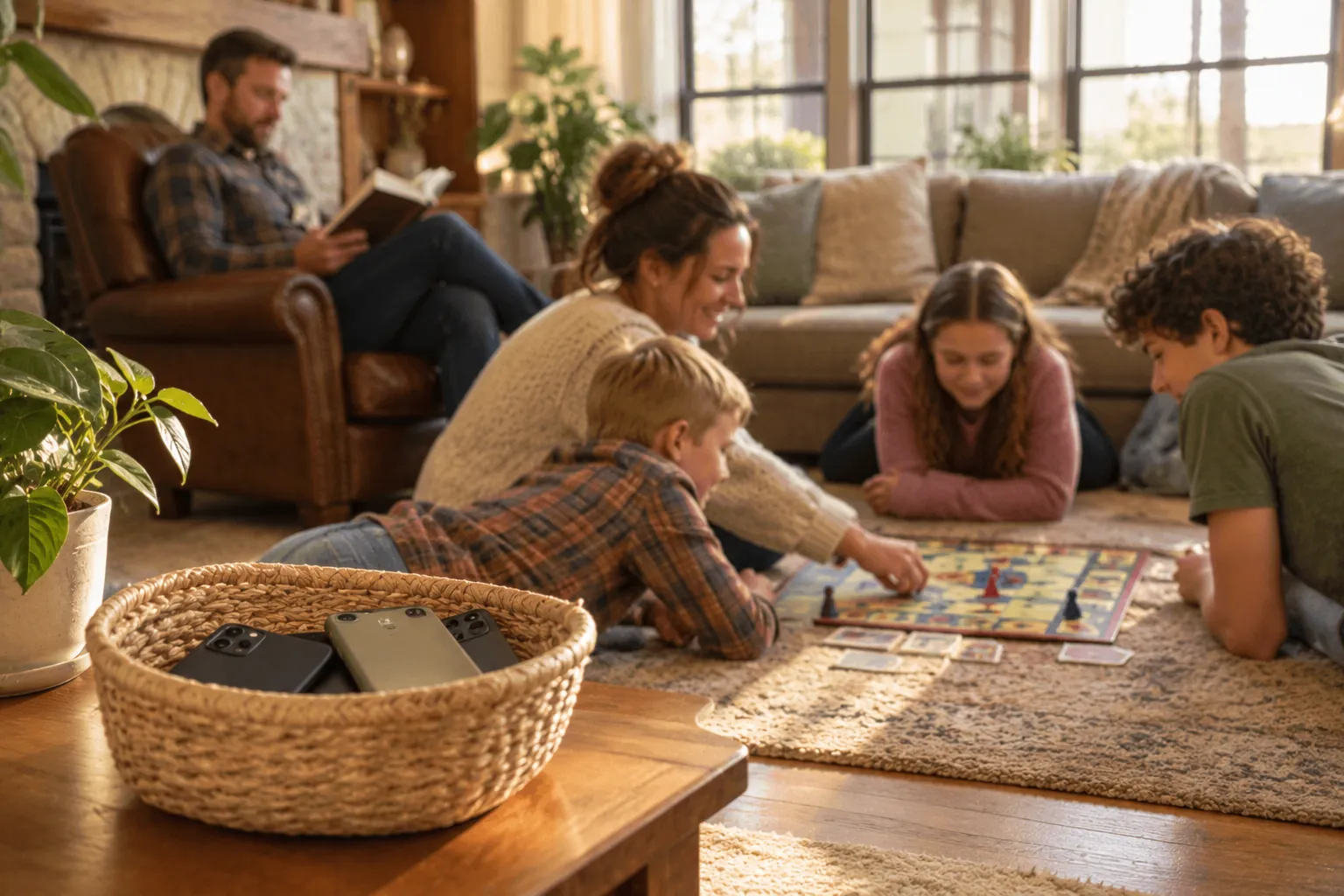
A practical step: give your phone a home for the day. A basket by the door, a drawer in the kitchen, a shelf in the bedroom. Out of sight helps far more than good intentions.
How do we set the rules without a battle?
Keep the rules few and decide them together. A family meeting the week before is a good place to talk it through.
Questions to answer as a family:
- Which day, and which hours? Many families begin with an afternoon and evening, then extend it once it feels natural.
- Which screens? Phones, tablets, games and television are the usual list. Some families keep one shared screen for a family movie in the evening.
- What are the exceptions? Calls with grandparents, navigation for a drive, music in the kitchen, a parent who is on call for work. Name them in advance so they do not become arguments.
- What happens on the day before? Charge devices and put them away the night before, so the day starts quiet.
Write the agreement down and post it where everyone can see. Keep it short enough to remember.
If a rule is not working after a few weeks, change it. A screen-quiet day should serve your family, not the other way around.
What do we do with all those hours?
This is the part that makes or breaks the day. If you take screens away and offer nothing in their place, children will be bored and resentful, and the day will feel like a punishment. The day has to offer something better.
Good things to fill it with:
- A long meal. Cook together, set the table nicely, and linger. Invite another family or a grandparent.
- Time outdoors. A walk, a hike, a bike ride, a picnic, a visit to a park you have never tried.
- Games. Board games, card games, puzzles. Keep a shelf of favorites ready for the day.
- Making things. Baking, drawing, building, gardening, music. Children often rediscover hobbies they had forgotten.
- Visiting. Neighbors, older relatives, friends who are lonely.
- Rest. Naps, reading on the couch, sitting on the porch. Boredom is allowed, and often leads somewhere good.
- Worship and quiet. Many families attend church, pray together or share a blessing at dinner as part of their day of rest.
You do not need to plan every hour. Have a few anchors, such as a family walk and a special dinner, and let the rest unfold.
Life together should be delightful, not just correct.
How do we handle teenagers and objections?
Teenagers usually have the most to lose socially and the strongest reaction. Take their concerns seriously. Their friends may make plans through their phones, and missing those plans can feel like a real loss.
Some ways to work with teenagers:
- Let them help set the rules, including the exceptions.
- Allow a short window, perhaps at the end of the day, to catch up on messages.
- Invite their friends over on the screen-quiet day so their social life comes to the family.
- Give them real ownership of part of the day, such as choosing the dinner menu or planning the afternoon outing.
When a child objects, listen first. "This is hard for you. What part is hardest?" is better than repeating the rule. Then hold the boundary kindly. Families that keep a rhythm through the first few weeks of grumbling usually find the grumbling fades.
How do we make it last?
Expect the first few weeks to feel awkward. Everyone will reach for a device out of habit. Hands will feel empty. That is normal, and it passes.
A few things help the habit stick:
- Keep the same day every week. Consistency turns an experiment into a rhythm.
- Make the day pleasant on purpose. A favorite food or a special activity gives everyone something to look forward to.
- Talk about it afterwards. At your weekly planning time, ask, "What was best about our quiet day?" Notice the good things together.
- Do not make it a source of guilt. If a week falls apart, start again the next week without a lecture.
Over time, many families find the quiet day becomes the one everyone protects.
Where Smarkle fits
Smarkle is a calm, private space for the rhythms your family keeps, and Sabbath rest sits at the heart of the method alongside Plan · Work · Celebrate. A screen-quiet day can live there as a weekly rhythm, with your family's agreement written down and your plans for the day shared in one place. You can read more about rhythms on the rhythms page and see the whole approach in the Smarkle method.