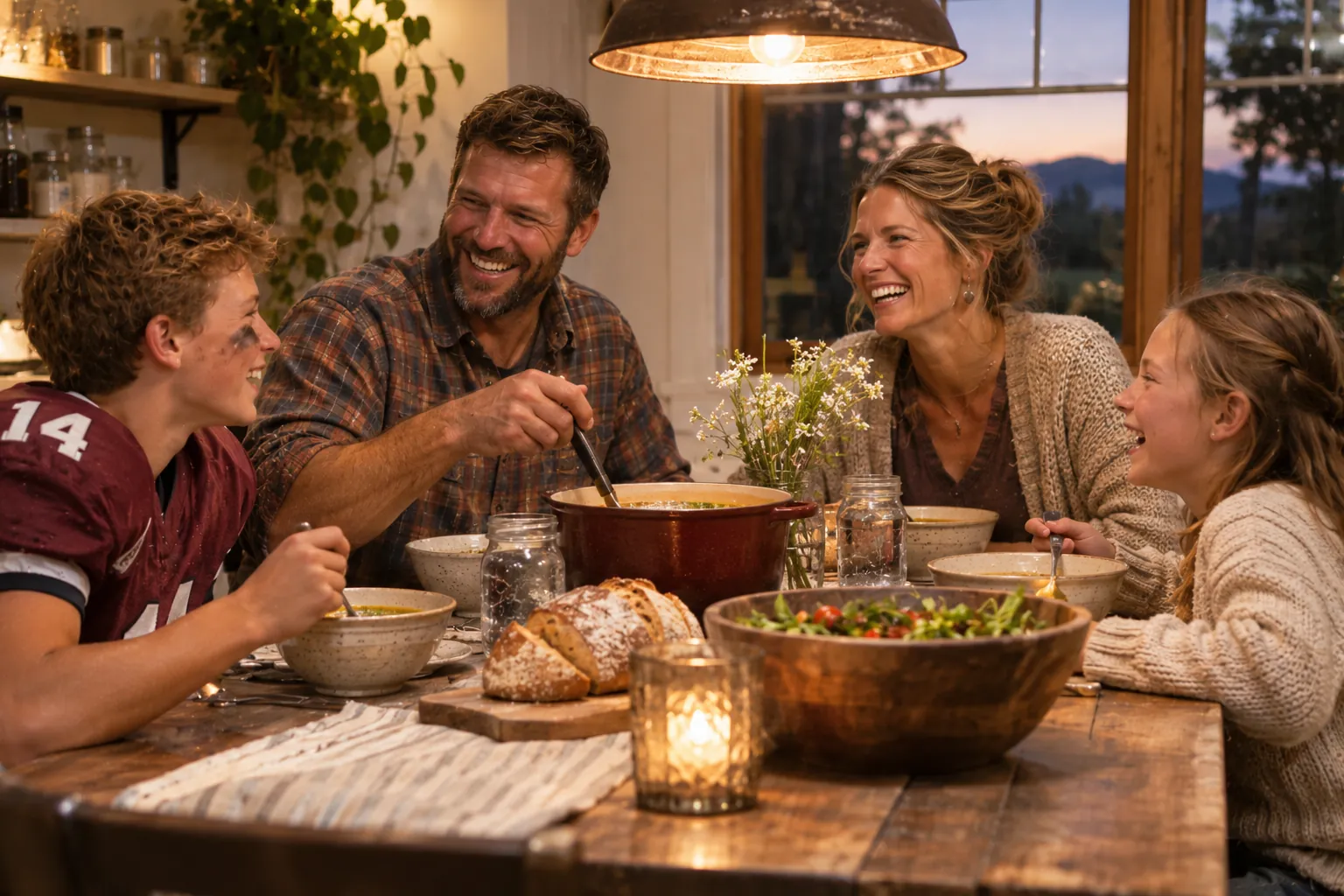
This is for families whose evenings are scattered across practices, late shifts, rehearsals and homework. It covers why the shared meal is worth protecting, how to choose the nights that matter, what to do when plans fall apart, and how to make the time at the table something people want to come back to.
Why does family dinner matter so much?
A meal is one of the few moments when a family naturally faces each other. Nobody needs an agenda. You eat, someone tells a story, someone else laughs, a worry slips out between bites. Over months and years, those small conversations add up to knowing each other.
Dinner also gives a family a heartbeat. When a meal happens on the same nights each week, everyone can lean on it. A child having a hard week knows there is a place to land on Thursday. That steadiness matters more than any single conversation.
None of this requires a perfect meal. Takeout eaten together counts. So do soup and toast. The point is the gathering, not the menu.
How many dinners together are enough?
Fewer than you might think, as long as they are protected. Many families do better aiming for two or three dinners a week that reliably happen than for seven that mostly don't. A rhythm you can keep beats an ideal you keep missing.
Start by looking honestly at the week. Which nights are already lost to practices or work? Which nights could work if one thing moved? Choose from those.
A mother of three working evening shifts might protect Sunday and Wednesday. A father whose teenagers both play sports might find that Monday is the only clear night, and build the week around it. A grandmother living with her daughter's family might cook on the night everyone is home and make that the anchor.
Once you choose, say it out loud: "Sunday and Wednesday, we eat together." A rhythm that has been named is far easier to defend.
One kept faithfully beats five that fade.
How do we protect those nights?
Treat the dinner like any other commitment that would be awkward to cancel. That means a few practical moves.
- Put it on the shared calendar. If it isn't written down, it loses to the first thing that is.
- Guard it when planning. When a new activity comes up, ask "does this touch our protected nights?" before saying yes.
- Keep the food simple. A protected dinner is not the night for an ambitious recipe. Plan easy meals for those nights, or cook double earlier in the week.
- Share the work. Let children set the table, stir a pot or choose the menu once a week. People are more likely to show up for a meal they helped make.
- Agree on phones. Many families keep devices away from the table during protected dinners, parents included.
Children will test it. A teenager may ask to skip for a friend's plans. Sometimes the answer can be yes. But if the answer is usually yes, the dinner is not really protected, and everyone will feel the difference.
What if dinner just won't work this week?
Some weeks fall apart. A tournament runs late, a parent travels, someone gets sick. That doesn't break the rhythm; it just calls for a fallback. Decide on a couple in advance, so nobody has to invent one under pressure.
- Late dessert. If dinner is impossible, gather for something sweet when everyone is finally home, even for fifteen minutes.
- Weekend breakfast. Pancakes on Saturday morning can carry the same warmth as a weeknight meal.
- Shift the time. Eat early with whoever is there, then sit with the late arrival while they eat.
- The car or the kitchen counter. A shared snack between activities can still be a real conversation if the phones stay down.
The rhythm is the promise to gather, not the clock time. Keep the promise in whatever form the week allows, and come back to the usual plan as soon as you can.
How do we make the table a place people want to be?
Protecting the time is half of it. The other half is making the time feel good. A dinner that turns into a lecture or a homework check will be quietly avoided.
A few habits help:
- Start with a blessing or a moment of thanks. It marks the beginning and settles the room.
- Ask better questions. Instead of "how was your day?", try "what made you laugh today?" or "what was hard this week?"
- Let everyone have a turn. Younger children especially need a moment when the table listens to them.
- Save hard topics for another time. Grades and chores can wait for a calmer setting. Dinner is for connection.
- Celebrate small things. A good test, a kind act, a first day somewhere new. Name it at the table.
Over time, the dinner becomes the place where the family's small celebrations naturally happen. That is when it starts to carry itself.
Where Smarkle fits
In Smarkle, a protected dinner is a rhythm: a cadence your family sets on purpose that slowly becomes part of how you live. Smarkle keeps that rhythm visible on a calm, private family calendar, alongside the fallbacks you have agreed on and the small moments worth remembering. You can read how rhythms work or browse rhythm ideas other families keep.