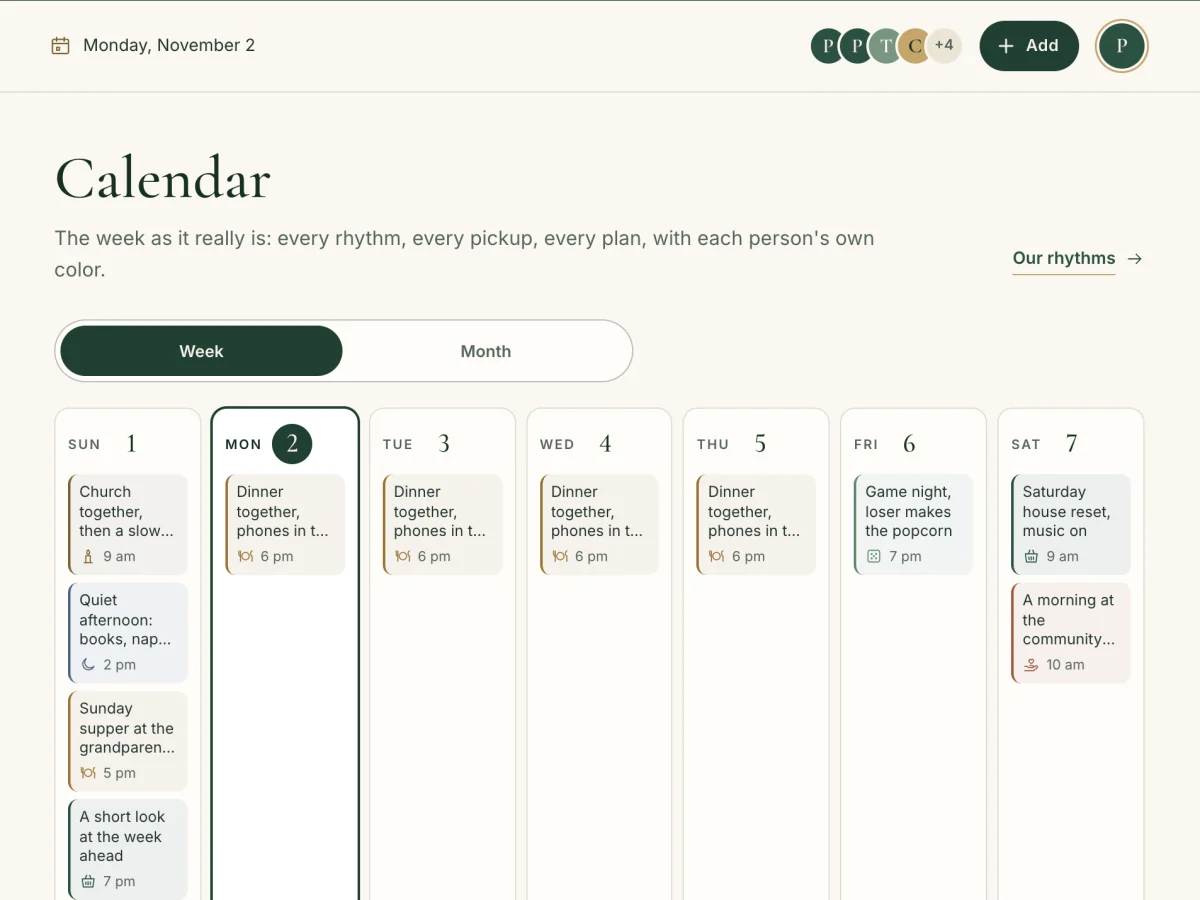
This is for parents who look at the year ahead and feel it filling up before they have chosen anything, or who reach December wondering where all the good intentions went. It covers why calendars get overloaded, the order to plan in, how to hold an annual planning sitting, how to protect open space, and how to keep the plan alive through the year.
Why do family calendars get so crowded?
Because the calendar fills in the order things are asked of you. School sends its dates. Sports leagues publish their seasons. Work adds its deadlines. Each request is reasonable, and each one takes a slot. By the time you think about a family trip or a quiet weekend, the year is already spoken for.
The result is a calendar that reflects other people's priorities more than your own. Nothing on it is bad. It is simply not chosen. And a family that never chooses its calendar often finds itself tired, scattered and short of the very things it values most.
The fix is not to say no to everything. It is to decide what goes in first.
What should go on the calendar first?
Think of it like filling a jar. If you pour in sand first, the big stones won't fit. Put the big stones in first, and the sand settles around them.
Your big stones might include:
- Weekly rhythms. A family dinner night, a weekly planning sitting, a Saturday outing, a Sunday of rest.
- A day of rest. Many families keep a Sabbath, or simply one slower day each week, with less planned and more time together.
- Birthdays and anniversaries. Each with a little room around it, not squeezed between commitments.
- Holidays and traditions. Christmas, Easter, Thanksgiving, a summer week at the lake, a first-day-of-school breakfast.
- Time away together. A family vacation, a long weekend, or a parents' retreat to talk about the year.
- Time for each child. A one-on-one outing with each child, a few times a year.
Write these in first, before you look at anything else. They are the frame of your year.
One kept faithfully beats five that fade.
How do we hold an annual planning sitting?
Set aside a few hours once a year, perhaps in late December or early January, or at the end of summer if your year turns with the school calendar. Some couples do this on a short parents' retreat. Others gather the whole family around the kitchen table.
A simple order to follow:
- Look back. What did we love last year? What wore us out? What do we want more of, and less of?
- Place the big stones. Rhythms, rest, birthdays, traditions and time away.
- Add the fixed dates. School terms, work trips, known events.
- Choose the activities. Decide together which sports, lessons and commitments each person will take on, and which will wait.
- Leave open space. Block off some weekends with nothing planned. Mark them clearly, so they don't get filled by default.
- Name the keepers. Decide who will plan each tradition or trip, so nothing depends on one tired parent.
Let older children join for the parts that affect them. A teenager choosing between two activities learns a great deal about trade-offs. A younger child can help choose the summer outing.
How do we protect open space?
Open time is the first thing to disappear, because it looks empty. To protect it, treat it like an appointment. Write "Home" or "Rest" on the calendar. When an invitation comes for that weekend, you can honestly say you already have plans.
A few habits that help:
- One open weekend a month. No commitments, no travel, just home.
- A limit on activities. Some families agree on one main activity per child per season.
- A buffer around big events. A quiet day after a trip or a holiday, so everyone can recover.
- A pause before saying yes. "Let me check our calendar and get back to you" gives you room to choose.
Saying no is easier when you can see what you are saying yes to. Slowing down an overscheduled family has more on deciding what to cut and how to say no without guilt.
How do we keep the plan alive through the year?
A yearly plan is only a guess. Life changes. Jobs shift, children grow, someone gets sick. The plan needs regular attention to stay useful.
Bring the calendar to your weekly planning sitting. Look ahead a week, and glance ahead a month. Is a birthday coming? Is a tradition approaching that needs preparation? Is the open weekend still open?
Once a season, look further. A short sitting each quarter lets you adjust: drop what isn't working, add something new, and check that the big stones are still in place.
And when the plan falls apart, as it sometimes will, don't abandon it. Simply put the next big stone back in place and carry on.