This is for parents who want their children to know where they come from. It covers why the story matters, how to tell it so it stays, what to do with heirlooms, a one-page family story, and what to do when your own family's story is a painful one.
Why does family history matter to children?
Children who know their family's story stand a little steadier. Not because the story is impressive, but because it tells them they belong to something larger than themselves. When a hard week comes, a child who knows that a grandmother started over in a new country, or that a great-uncle lost a farm and built another, has somewhere to put the hard week: our family has been through hard things before, and came through.
The steadying part is often the difficult part. A family story made only of triumphs is a brochure, and children can tell. A story that includes the lean years, the illness, the argument that took a decade to heal, and how the family got through it, gives a child something more useful than pride. It gives them a pattern: things go wrong, and families keep going.
So tell the real story, at a level your child can carry. A six-year-old needs to know that Grandpa's family was very poor for a while and that they shared one bedroom. A teenager can hear more about why.
Tell the real story, not a perfect one: children need heroes with scars.
How do you tell it so it actually sticks?
Children rarely remember history given in one sitting. They remember what they hear many times, in small doses, in places that feel warm.
- Use the table. Dinner is the natural home for family stories. One short story, told well, is worth more than a long account nobody finishes. "Did I ever tell you how your grandparents met?" is an easy opening.
- Tell it when something prompts it. A snowstorm is the moment for the story of the winter the power went out at Grandma's house. A first job is the moment for the story of a parent's first job. Let life hand you the cue.
- Repeat the favorites. Repetition is how a story moves from something they were told to something they know.
- Hand the telling over. Once a child knows a story, ask them to tell it to a younger sibling or a visiting cousin. Telling a story is how it becomes theirs.
A father of three found his children ignored his careful explanations of where the family came from. What caught them was a single line he repeated every time the family drove past the river: "That's where your great-grandfather swam across with his shoes tied round his neck." They now say it before he does.
How do objects and places help children remember?
A story tied to something you can hold or stand in is far easier to remember than a story floating in the air. Objects and places are anchors.
Walk through your home and notice what already carries history: a quilt, a toolbox, a recipe card, a clock, a well-worn Bible. Each one is an invitation. "This was your great-grandmother's. Here's what she used it for." Visit the places too, when you can: the old neighborhood, the church where your parents married, the town where a grandparent grew up. Standing in a place makes a story real.
Here is what most families miss. An heirloom without its story is just a thing. Two generations on, the quilt is a quilt and the clock is a clock, and nobody remembers why they mattered. So record the story with the object. Write a short note and keep it with the heirloom, in the drawer or taped inside the lid. Better still, record someone telling the story and keep it where the family can find it, alongside a photograph of the object. If a grandparent is still with you, ask them to tell the stories behind the things in their home while they can.
A small habit helps: whenever something is handed down, its story goes with it, and someone writes it down.
What is a one-page family story?
Children need a version of the family history short enough to carry. A one-page family story is exactly that: a few paragraphs, written in plain words, that a child could read in a few minutes and tell back to you at the table.
Write a first draft yourself and read it aloud for the family to improve. It might cover:
- Where we come from. The places and people a few generations back, as far as you know them.
- What we went through. One or two hard seasons, honestly told.
- The turning points. The moments the family chose a different direction: a move, a new start, a decision to forgive, a faith taken up, a habit broken.
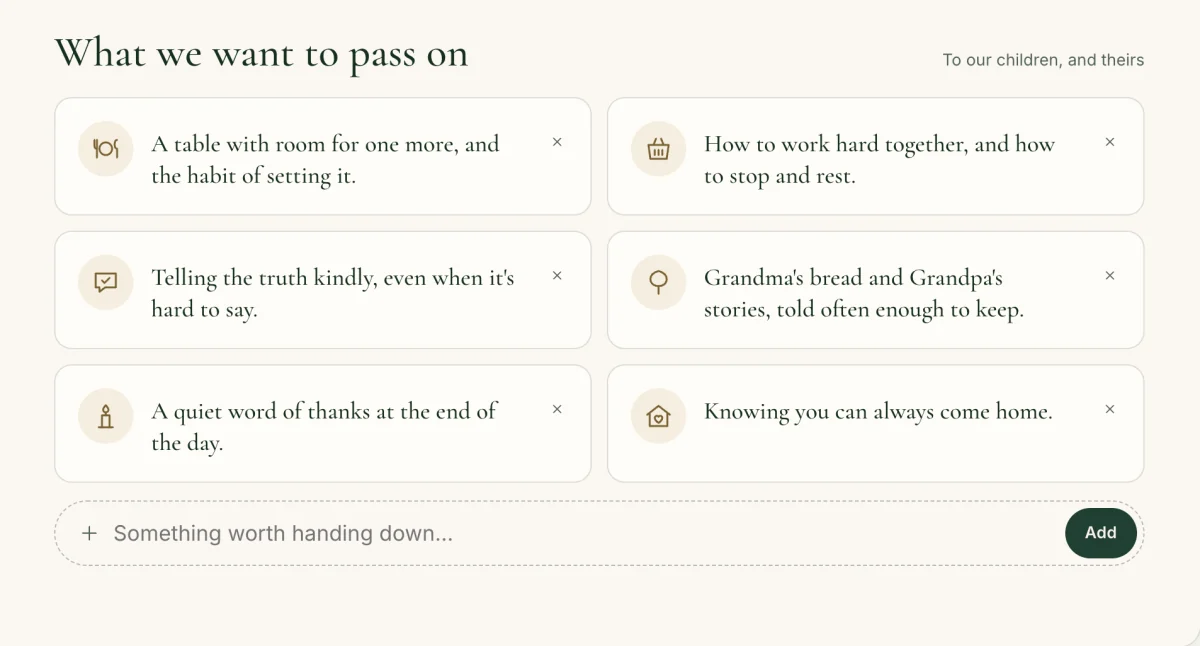
- What we hold to. The handful of things your family has tried to keep, drawn from the story itself.
- Where you come in. A sentence that tells the child they are part of this now, and the story keeps going with them.
Keep it short on purpose. A long history belongs in a binder; the one-page story belongs in a child's memory. When a child can tell it back in their own words, it has done its job. Read it aloud once a year, on a birthday or a holiday, and let it grow as the children do.
What if your own family story is a hard one?
Some parents hesitate here, because the story they come from includes things they don't want to hand on: addiction, abandonment, a home where nobody was safe. It can feel kinder to say nothing.
You don't have to tell children everything. But silence often leaves a gap that children fill with guesses. And there is something important you can tell them, plainly and at the right age: the family story changed, and here is where it changed.
The parent who came from a hard family story can be the turning point in it. A mother who grew up with a father who drank, and who chose a different kind of home, has a story worth telling her children, not as a warning but as an inheritance. "My father struggled with alcohol, and it made our house frightening. When I had you, I decided our house would be different. That's part of why we do things the way we do."
Tell it with care, and only what each child is ready for. Speak about the people who hurt you honestly but without contempt; they are part of your child's story too. If the telling stirs up more than you expected, talk it through with a counselor or a trusted friend first.