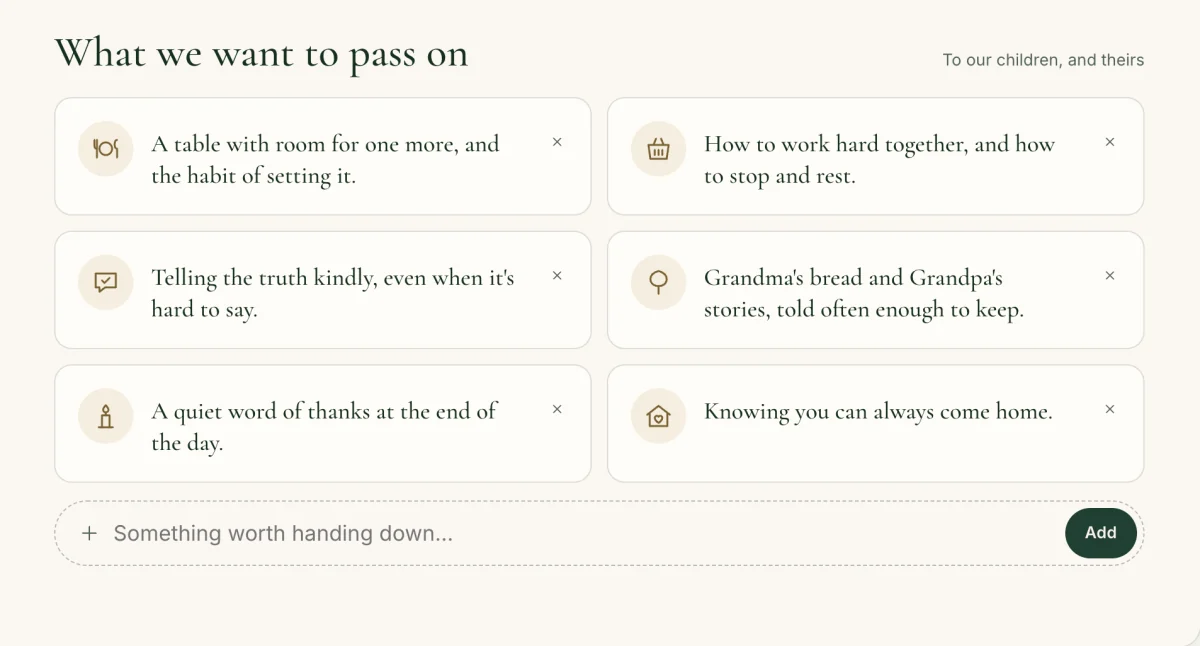
This is for parents and grandparents who want what they care about most to outlast them. It covers why talking alone rarely works, how to put your values into words, how to build them into ordinary weeks, and how to leave a letter that hands on what you learned rather than what you own.
Why don't lectures pass values on?
Children are always watching, and they believe what they see over what they hear. A father who talks about honesty but shades the truth on the phone has taught a lesson, just not the one he meant. A grandmother who never mentions generosity but always sets an extra place at the table has taught one too.
Lectures also arrive at the wrong moment. They usually come after something has gone wrong, when a child feels defensive and the adult feels frustrated.
What sticks is what repeats. The thing your family does every week, the way you speak to each other when you disagree, the question that is always asked at dinner. Over years these become a child's sense of what normal is, and what normal is becomes what they carry into homes of their own.
How do you name your family's values?
Most families have values. Few have ever said them out loud. Naming them gives everyone a shared language, and it gives grown children something to come back to when they are building a family of their own.
Keep it short. A handful of principles, each in a few plain words, is enough. Long lists get forgotten.
- Start with what you already do. Ask, "What do we do that we'd want our grandchildren to do?" The answers are often closer to real values than anything you'd invent.
- Use your family's own words. "We tell the truth, even when it costs us." "We show up for each other." "We leave places better than we found them." Plain sentences are easier to remember than single abstract words.
- Add a line of why. One sentence on why it matters to you keeps the principle from becoming a slogan.
- Write them down and keep them where people can find them. A page in a shared place, a card on the kitchen wall, a list read aloud on a birthday.
Hold them loosely enough to grow. Your grown children will live these principles in different houses, different cities and different seasons of life. The goal is not that they copy your household exactly. It's that they recognize the principle and shape it to their own family.
How do you live your values in rhythms?
A value without a practice tends to fade. A value with a rhythm becomes part of who the family is.
For each principle you name, ask one question: what would we actually do, again and again, if we meant this? Then choose something small and give it a place on the calendar.
- If you value gratitude, each person names one good thing at Sunday dinner.
- If you value service, the family helps a neighbor together once a month.
- If you value rest, one day a week is kept quieter, with a meal together, a walk, and perhaps a blessing or a prayer before eating.
- If you value hard work, children have real jobs in the house, done on a set day.
A rhythm is a cadence set on purpose. After a few years, the children stop thinking of it as something the family does and start thinking of it as who the family is. That is the moment a value has truly been handed on.
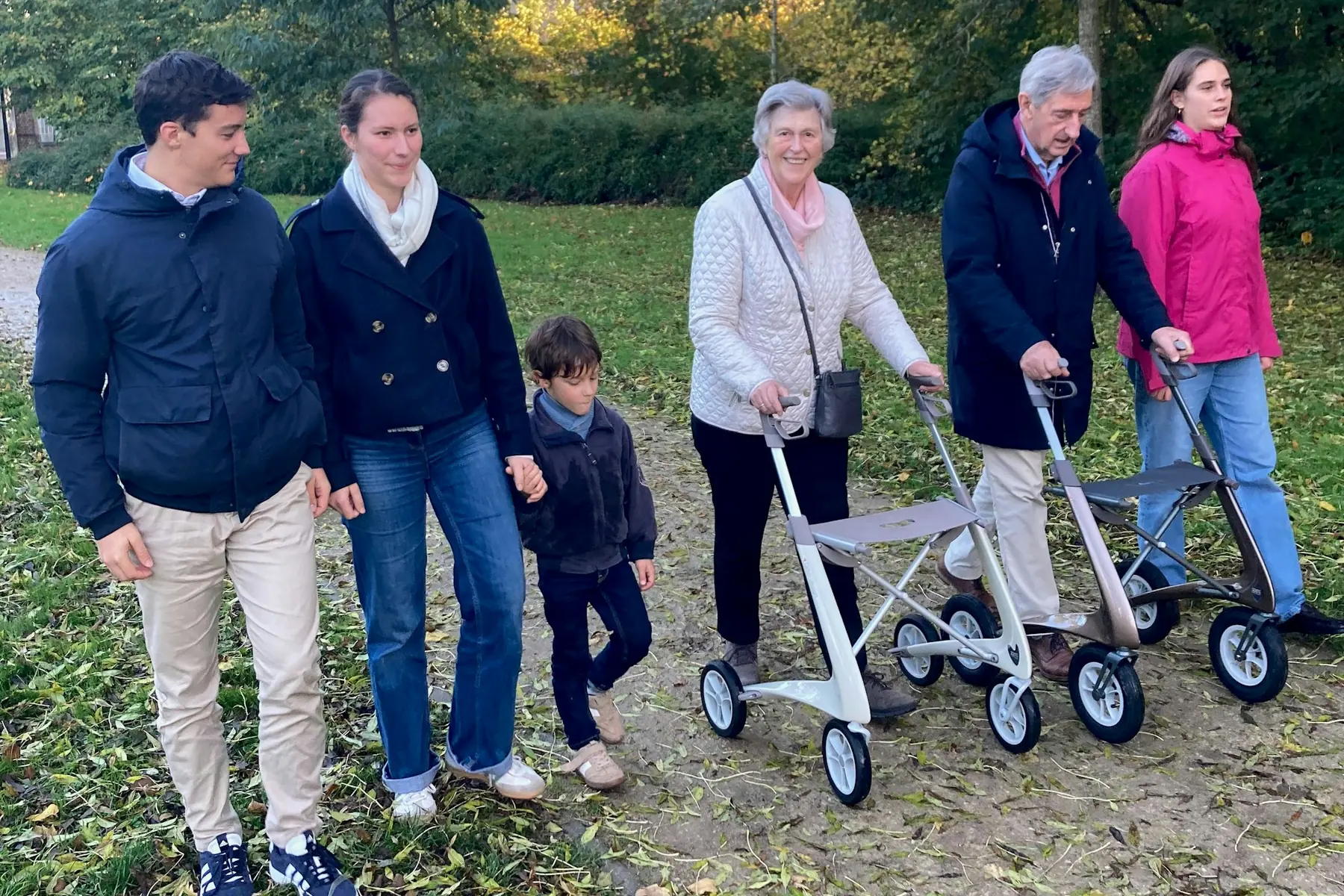
Your family has a recognizable way of living together, and it's being handed on.
Why does the story behind a value matter?
Children remember stories long after they forget instructions. A principle with a story attached becomes theirs in a way a rule never does.
Tell the story of where your values came from. The grandfather who walked back into a shop to return the extra change. The hard year when the family had little and a neighbor quietly paid for the groceries, and why your family has helped others ever since. The mistake you made at nineteen and what it taught you.
Be honest in these stories, including about your failures. Children trust a parent who admits getting it wrong far more than one who seems never to have struggled. A mother who says, "I learned this the hard way, and I'd love you to learn it more gently," is passing on something real.
Tell the stories more than once, and let grandparents and older children tell them too. Repetition is what makes a story belong to everyone.
How do children practice values with real responsibility?
Values are learned by doing. A child who has never been trusted with anything that matters finds it hard to believe that responsibility is a family value.
Give children real work and real trust, sized to their age. A young child can feed the dog every morning. An older child can plan and cook one family meal a week. A teenager can manage a small budget for the family's camping trip or care for a younger sibling for an afternoon.
The point is ownership, not perfection. When a child owns something, they practice faithfulness, care and follow-through in a way no conversation can teach. When they fall short, that is part of the learning. Talk about it calmly, help them try again, and resist taking the job back.
Let children practice your principles in their own ways too. A daughter who values kindness might start writing notes to a lonely neighbor. That's the value taking root in her, and it deserves noticing and celebrating.
How do you write a letter of what matters most?
One of the oldest ways to pass on values is a letter. It is sometimes called an ethical will: not a list of who gets the house or the watch, but a letter that passes on what you learned and what you hope for the people you love.
It doesn't need to be long or polished. A few pages in your own voice are worth more than anything formal.
- What you believe matters most, and why you came to believe it.
- What you learned the hard way, so they might learn it more gently.
- What you are grateful for, in your life and in them.
- What you hope for them, without demanding they become a copy of you.
- Any forgiveness you want to ask for or offer.
Some parents write one letter to the whole family. Others write a short one to each child or grandchild. Some read theirs aloud at a family gathering. Others seal it to be opened at a milestone, such as a wedding or the birth of a first child. Any of these is right. Write it long before it's needed; the writing itself often shows you what you care about.