This is for parents who want their home to be more than an asset on a will. It covers why a house becomes an inheritance, how children can help build and mend it, how to keep its story, and how to talk about the future of the house and the things in it without anyone feeling uneasy.
What makes a house worth passing down?
A house can be sold. A home has to be handed on.
The market sees square footage, a roof and a neighborhood. Your children see something else: the step where they sat to tie their shoes, the kitchen counter where every birthday cake was frosted, the door frame with their heights pencilled up the side. Those things carry no price, and they are exactly what your children will miss.
A well-made house helps. Sound framing, honest materials and careful joinery last long enough to be handed on at all. But even the finest house becomes an inheritance only when people have lived in it with attention. The craft gives it a long life. The family gives it a reason to be kept.
So the real question is how to make this house theirs while you all still live in it. The answer is ordinary: work, stories and care, repeated over years.
How can children do real work on the home?
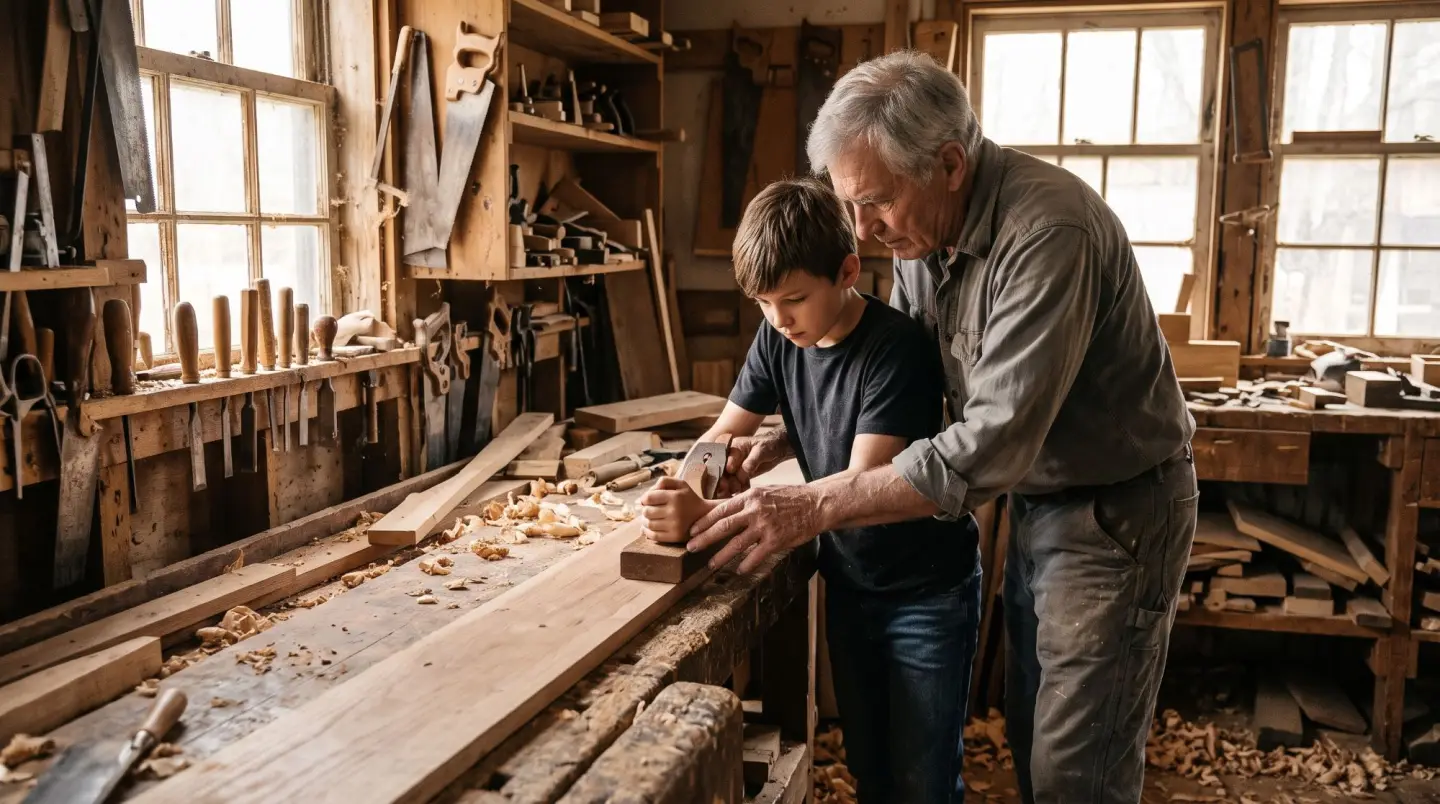
The shelf a child helped build is theirs forever. They will point it out to their own children. They will notice if someone takes it down.
Children don't need pretend tasks. They need real ones, sized to their hands.
- Little ones can hand you screws, hold the tape measure, sweep sawdust, plant bulbs along the walk and paint the bottom boards of the fence.
- Older children can sand, drill pilot holes, measure twice, patch a nail hole, rehang a cabinet door and fix the dripping tap with you beside them.
- Teenagers can plan and finish a whole small project: a bench for the porch, new trim in their own room, a raised garden bed, a shed shelf that holds the tools properly.
Let them sign it. A name pencilled on the underside of a shelf or the back of a cabinet door, with the season and year written out, turns a chore into a mark. Years from now someone will find it.
Expect it to be slower than doing it yourself. A father of three spent a whole Saturday rebuilding the back steps with his middle son, a job he could have finished alone in a morning. The steps are a little uneven. His son, now grown, still calls them his steps.
Make it a rhythm rather than a one-off. One real project each season, chosen together, teaches that a home is something you look after, not something that simply happens around you.
A shared project might become a child's first real stewardship.
How do you keep the story of the house?
Houses forget quickly. Nobody remembers why the odd window is there, or which tree was planted the spring the baby came home.
Keep a house book. It can be a plain notebook on a kitchen shelf or a shared folder of photos and notes. Simple is better than beautiful, because simple gets kept.
What belongs in it:
- Who built or changed what, and when, in plain words: "Mom and the girls painted the front door blue the summer after the flood."
- What was repaired, and how. The roof patched, the stair tread replaced, the furnace finally fixed. Future owners and your own children will thank you.
- The marks of growing up. Photograph the door frame with the height lines. If you ever paint it, photograph it first, or better, leave it alone.
- Where things came from. The table built from the old barn boards, the quilt rack a grandfather made, the stone a child carried home from the river.
Add a photo and a few sentences whenever you finish a project. Let children write their own entries, spelling and all.
A grandmother living with her daughter's family started a house book by walking room to room with her grandchildren and telling them what each room had seen. They wrote it down as she talked. It took a month of short evenings, and it is now the thing in the house they would save first.
What does it mean to tend a home as stewards?
Owners think about what a house is worth. Stewards think about what it needs.
Stewardship is the quiet work of keeping a place sound and good for the people who come after you. Clearing the gutters before winter. Oiling the wooden door. Fixing the small leak before it becomes a large one. Planting a tree you may not sit under.
Children learn stewardship by watching it and then doing it. Walk the house together once a season and ask simple questions. What needs mending? What needs cleaning? What would make this place kinder to live in? Write the answers down, choose one or two, and do them together.
When a family tends its house together, the house stops being a backdrop and becomes a shared trust. Some families mark the end of a season's work with a simple meal, a blessing at the table and a walk around to see what was done.
How do you decide together what the house and its things mean?
This is the conversation most families put off, because it touches on age, illness and loss. It doesn't have to be heavy. Held early, while everyone is well, it is mostly a conversation about love and memory.
Start with meaning rather than ownership. Gather the family and ask:
- "What in this house matters most to you, and why?"
- "If we ever had to leave, what would you want to keep?"
- "Is there anything here you would treasure that we might not guess?"
You will be surprised. A grown son may care nothing for the dining set but deeply want the old tool chest. A daughter may ask for the kitchen chair she always sat in. Write it all down in the house book. These are not promises or legal plans, just a record of what each person treasures, so no one has to guess later.
Talk honestly about the house itself, too. Some homes will stay in the family. Many won't, and that is fine. A family can sell a house and still pass on its story, its marks and its best-loved things. Say this plainly, so no one carries a burden they never agreed to.
Revisit the conversation every few years as children grow. When formal decisions come, your family will already know what matters to each person.