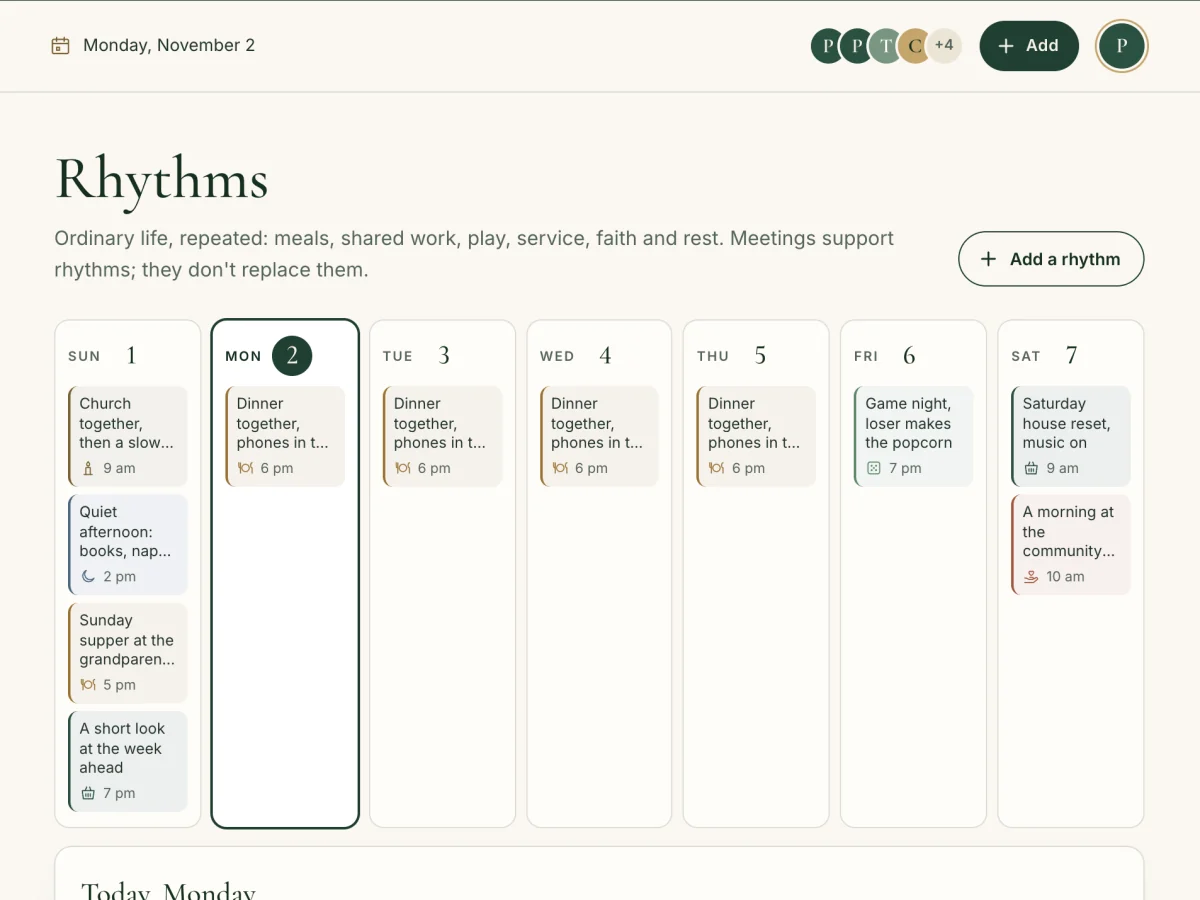
This is for parents who notice that evenings have dissolved into separate glowing rooms, and who are tired of arguing about it. Maybe you are tired of your own scrolling too. It covers why evenings are worth protecting, how to set up a screen-quiet night, what to put in the space screens leave, how to handle the hard parts, and how to keep it going when the novelty wears off.
Why do evenings slip away to screens?
Because evenings are when everyone is tired. After a day of school and work, a screen asks nothing of you. It is the easiest thing in the room, and easy wins when energy is low. Nobody decides to spend three hours apart. It happens one show, one game, one message at a time.
That is worth saying plainly, because many parents carry a quiet guilt about it. The screens are not proof that your family is failing. They are proof that your family is tired and that nothing else has been made easy. The answer is not more willpower. It is a better default.
There is also something real at stake. Evenings are often the only unhurried hours a family shares. The conversations that matter, about a hard day, a worry, a friend, tend to surface sideways, while hands are busy and nobody is staring at anyone. Screens close off those moments without anyone noticing.
What should we put in place of the screens?
This is the heart of it. Taking screens away and leaving an empty evening feels like punishment, and punishment does not last. Replace first. A few things that work well:
- A games box. Card games, a simple board game, dice, a deck of questions. Keep it in one place, ready to open.
- A read-aloud. One chapter a night from a book the whole family can follow. Even teenagers often drift in to listen if no one makes a fuss about it.
- A project waiting on the table. A puzzle, a model, a drawing pad, a jar of beads. Something that can be picked up and put down without setup.
- Cooking or baking. Make tomorrow's lunch or a simple dessert together.
- A walk after dinner. Twenty minutes around the block, in any weather you can bear.
- Music. Someone practicing, a record playing, an old song everyone half knows.
You do not need all of these. You need one or two that suit your family, set up so well that choosing them is as easy as choosing a screen. The project on the table is quietly powerful: it invites without asking.
Life together should be delightful, not just correct.
How do we set up a screen-quiet evening?
Keep the first version modest. One or two evenings a week is a real start, and a rhythm you keep beats an ambitious plan that collapses by the second week.
- Pick the nights. Choose evenings when most of the family is home. Name them. "Tuesday and Thursday are quiet evenings."
- Set the window. From after dinner until bedtime is common. Some families choose a single hour. Choose a stretch you can actually hold.
- Give devices a home. A basket, a drawer or a charging shelf away from the living room. Phones go there, and that includes the adults' phones.
- Agree on exceptions. Homework that needs a computer, a call with a grandparent, a parent on call for work. Name them ahead of time so they are not argued nightly.
- Prepare the replacement. Set out the games box or the book before the evening starts.
Parents going first matters more than any rule. Children notice very quickly whether the basket holds every phone or only theirs. If you need your phone for something, say so out loud and put it back when you are done.
What about teenagers and homework?
Teenagers deserve a voice in the plan, not just a notice of it. Ask them which nights work and what they would actually enjoy doing. A teenager who chooses the Thursday game may defend that night more fiercely than you do.
Homework is a real exception, and it is fair to say so. Many families let a laptop stay out for schoolwork, used at the kitchen table rather than behind a closed door. Messages to friends can wait until the quiet window ends. Say that kindly and in advance, not as a sudden rule. If you already have a written screen agreement, fold the quiet evenings into it; a family screen agreement covers the wider ground.
Expect a few evenings of grumbling. That is normal. Boredom is often the doorway to something better, and children who sit with it for a little while usually find their way to the games box or the sketchbook.
How do we keep it going after the first few weeks?
The first weeks run on novelty. After that, a rhythm needs care.
- Keep it pleasant. If quiet evenings become a time for chores and lectures, people will dread them. Keep them a little special: a favorite snack, the good blanket, the lamp instead of the overhead light.
- Rotate who chooses. Let each person pick the evening's activity in turn.
- Talk about it at your weekly planning. Ask what people enjoyed and what to change. Adjust the nights or the window if they are not working.
- Restart without a speech. A missed week is not a failure. Just begin again on the next quiet night.
Over time, the evenings stop feeling like a rule and start feeling like who you are. That is the moment a cadence set on purpose has become life. If you want a fuller day of rest from screens, a digital Sabbath builds on the same idea.