This is for families who have had a genuinely good talk, felt hopeful, and watched nothing change by the following week. If that has happened more than once, it is easy to decide family meetings do not work, or that your family cannot change. Neither is true. This article covers why good intentions fade, how to give each decision a home, how to follow up without nagging, and what to do when old habits return.
Why do good decisions fade so quickly?
Because a decision is a moment, and life is a current. At the table everyone agrees: we will eat together more, we will stop yelling in the mornings, the kids will take on the dishes. The agreement is sincere. Then Monday arrives with its alarms and rides and deadlines, and the old patterns are simply easier.
Nobody is lying when they agree. They are just tired by Tuesday. Habits run on autopilot, and a new intention has no autopilot yet. Unless something carries the decision forward, the current carries it away.
There is also a quieter reason. Many decisions are made in the general: "We should be kinder to each other." That is a good wish, but it gives nobody anything to do on Wednesday at six. Vague decisions fade fastest.
How do we give each decision a home?
Before the meeting closes, take each decision and ask one question: "What will make this actually happen?" There are three good answers.
A rhythm
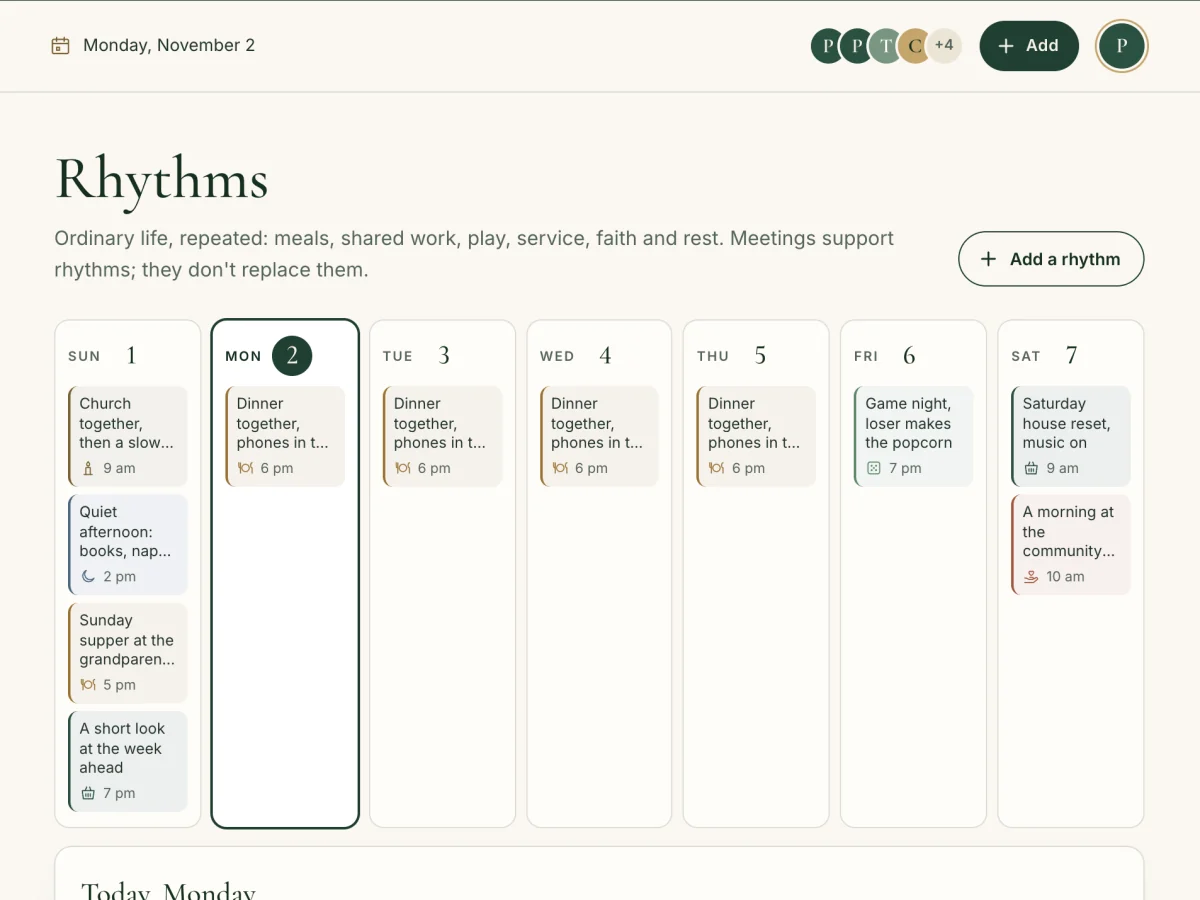
Some changes are about how often. "We'll eat together more" becomes "Tuesday and Friday dinners at the table, phones in the basket." A rhythm has a day and a time. It turns a hope into a cadence. A cadence set on purpose slowly becomes life.
A reminder
Some changes need a nudge until they become natural. Write the decision on a card on the fridge, put it in the shared calendar, or set a reminder on the phone of whoever needs it. "Shoes go in the bin by the door" works better taped above the bin than spoken once at a meeting.
An owner
Some changes need a person. Ask who will carry it, and let them choose. "Who wants to own the Saturday morning breakfast?" A fourteen-year-old who volunteers to plan it will think about it during the week in a way nobody else will. Owning means the whole job: remembering, preparing, and saying when help is needed.
Many decisions need two of these. A new chore rotation needs an owner who keeps the chart and a reminder on the wall. Before you close, read the list back aloud: what was decided, what makes it happen, and who owns it.
Ideas are cheap. Implementing and owning them is what really counts.
How do we make fewer, better decisions?
It is tempting, after a good talk, to fix everything at once. That is usually why nothing changes. Five new agreements compete with each other for attention, and all of them lose.
Choose one or two changes per meeting. Make them specific enough that anyone could tell whether they happened. "Be more helpful" cannot be checked. "Each person clears their own plate after dinner" can.
If more ideas come up, write them on a "later" list and come back to them once the first changes have settled. A change that sticks makes the next one easier, because the family begins to believe it can change. That belief is worth more than any single agreement.
How do we follow up without nagging?
Start the next meeting by looking back. A simple pattern:
- Read the decisions from last time.
- Ask each owner how it went, and let them answer first.
- Celebrate what worked, even partly. "We ate together three nights. That's more than before."
- Adjust what did not. Change the day, the time or the owner, without blame.
The tone matters more than the format. Following up is for learning and adjusting, never for ranking anyone. If a child forgot their job all week, the question is "What would help you remember?" rather than "Why didn't you do it?" The first invites a better plan. The second invites hiding.
Between meetings, a light touch works best. A quick "How's the breakfast plan coming?" is encouragement. A daily reminder to the same person starts to feel like surveillance. If someone needs daily prompting, the plan probably needs a better reminder, not a louder parent.
What do we do when old habits come back?
They will. Every family slides back sometimes. A sick week, a holiday, a busy season, and suddenly the old way has returned without anyone deciding. That does not mean the change failed. It means the change is still young.
Name it calmly at the next meeting: "We drifted back on dinners. Do we still want them?" If the answer is yes, restart without a speech. If the answer is no, let it go honestly and choose something that fits better. A change you have outgrown is not worth defending.
Sometimes the slide reveals something real. If one person keeps missing their part, there may be an issue underneath: they feel overloaded, or never wanted the job, or something else is going on. That is worth a gentle conversation on its own, away from the table. A weekly family huddle is a good place to catch these early, and turning a family vision into rhythms covers the bigger picture of how intentions become habits.