This is for grown brothers and sisters who suddenly find themselves deciding together about a mother's driving, a father's health, money, housing or care, and discovering that old family patterns have come back with surprising force. If you are angry, hurt or exhausted, that is understandable. Caring for a parent stirs love, fear and grief all at once. This article covers why these conflicts happen, how to talk through them, how to share the work fairly, and when to bring in outside help.
Why do siblings clash so hard over this?
Because the stakes are high and the old roles are still there. When a parent begins to need help, siblings who have lived separate adult lives are suddenly making serious decisions together, often quickly and under strain.
A few common sources of tension:
- Uneven proximity. The sibling who lives nearby carries the daily load. The ones far away see only snapshots and may question decisions they didn't witness.
- Different readings of the situation. One sees a parent who is slipping; another sees a parent who just needs a little help.
- Old roles. The responsible one, the baby, the one who always argued with Dad. Those parts come back fast under pressure.
- Money. Who pays, who inherits, who is spending what, and whether anyone is keeping track.
- Grief. Watching a parent age is a slow loss. Grief often comes out sideways as irritation with each other.
Naming these openly takes away some of their power. The conflict is rarely about who is right. It is usually about who feels unseen.
How do we start talking about it?
Before a crisis, if you can. A calm conversation while your parent is still well goes much better than an emergency phone call from a hospital hallway.
Set a time when all siblings can join, in person or by video. Keep the first conversation focused on understanding, not deciding. A simple shape works:
- What each of us is seeing. Let every sibling describe what they've noticed, without interruption.
- What Mom or Dad wants. What have they said about where they want to live, how they want to be cared for, and what matters most to them?
- What we're worried about. Safety, money, loneliness, health.
- What each of us can offer. Time, money, skills, a spare room, phone calls.
Write down what you agree on and what is still open. Agree on a next time to talk. Questions held openly between siblings are much easier than questions that each person carries alone.
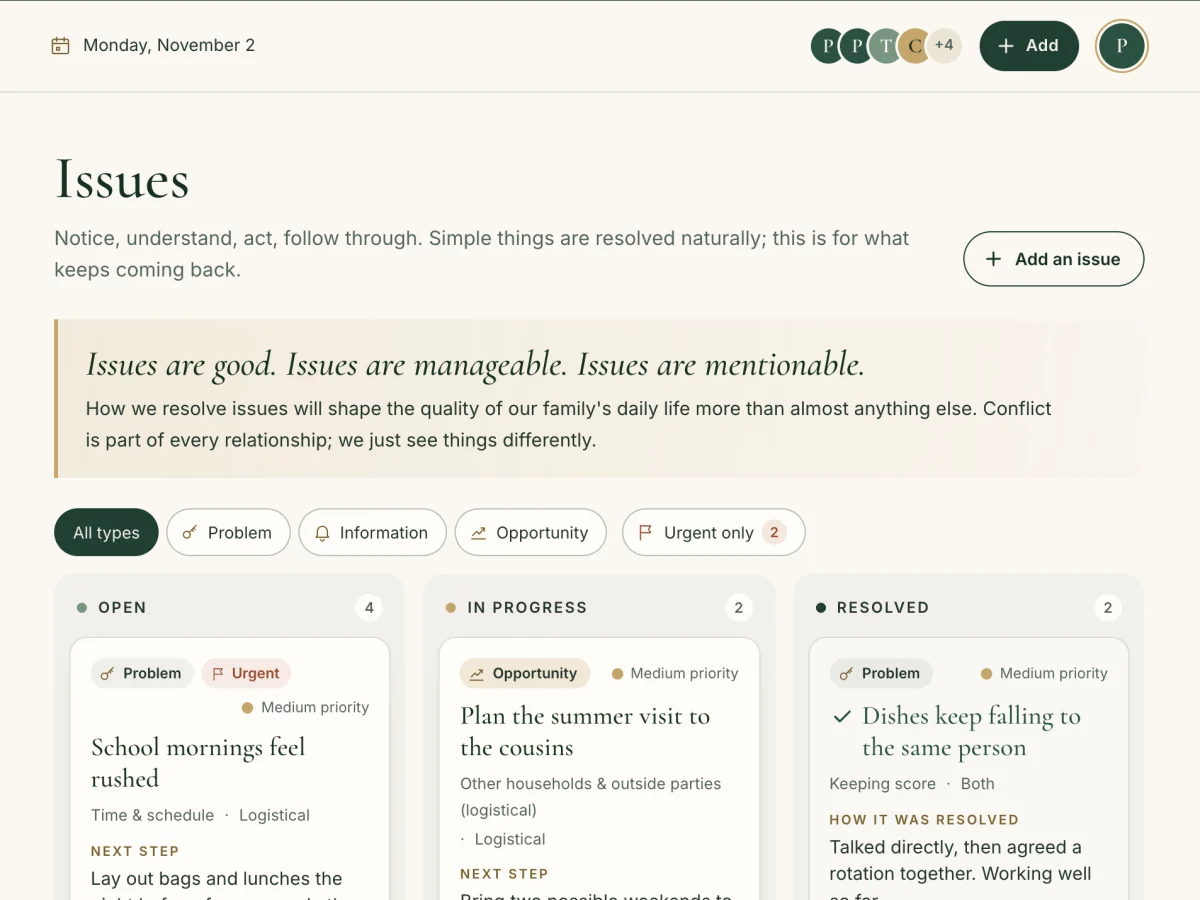
Issues are good. Issues are manageable. Issues are mentionable.
How do we keep our parent at the center?
It is easy for siblings to argue about a parent as if the parent weren't there. But unless they are unable to decide for themselves, the decisions are theirs. Your role is to support their wishes, not replace them.
Include your parent in the conversation whenever possible. Ask what they want, not only what they need. A father may care more about staying in his own home than about any particular level of care. A mother may want help with meals but feel humiliated by help with bathing. Their dignity matters as much as their safety.
When a parent can no longer decide, try to act as they would have wanted, based on what they have said over the years. If they have written down their wishes or chosen someone to speak for them, honor that, even if you would have chosen differently.
How do we share the work fairly?
Fair doesn't mean equal. It means openly agreed. Siblings have different distances, jobs, families and strengths, and the work of caring for a parent comes in many forms.
A few kinds of work to divide:
- Daily or weekly presence. Visits, meals, rides to appointments.
- Medical coordination. Talking with doctors, tracking medicines, keeping records.
- Money and paperwork. Bills, insurance, benefits, accounts.
- Companionship. Regular phone calls, letters, visits that are just for fun.
- Respite. Giving the main caregiver real breaks, including taking over for a weekend or a week.
Make the division visible. A shared list of who does what, reviewed every month or two, prevents resentment from growing in the dark. Most importantly, thank the sibling carrying the daily load, often and specifically. That person is usually more tired than anyone else realizes.
What do we do when we truly disagree?
Some disagreements won't resolve in one conversation. When they don't, slow down rather than escalating. A few practices help:
- Separate the decision from the history. "We're deciding about the house, not about who Dad liked best."
- Ask what each person is afraid of. Underneath most positions is a fear: that a parent will fall, that money will run out, that someone will be left out.
- Agree on a trial. "Let's try in-home help for three months, then look again together."
- Bring in a neutral voice. A doctor, a social worker, a pastor or a family mediator can help siblings hear each other.
Conflict is normal. Repair is the skill. After a hard conversation, reach out to the sibling you clashed with. A short message, "I know that was hard. I love you, and I'm glad we're in this together," keeps the relationship intact even while the question stays open. The essay on siblings staying close as adults has more on keeping that bond strong.
When should we get outside help?
If you suspect a parent is being harmed, neglected or financially exploited, by anyone including a family member, contact local adult protective services or a professional right away. Safety comes first, before any family conversation.
Outside help is also wise when care needs outgrow what siblings can manage, when conflict has stopped all progress, or when a caregiver is burning out. Doctors, social workers, elder care advisors, attorneys and counselors can all bring clarity. Asking for help is part of caring well.