This is for the parent who feels like the household's memory, the one who knows when the dentist is due and that the milk is low, and for the partner who wants to help but keeps being handed lists. It covers what the mental load is, why asking for help rarely fixes it, how to divide it well, and how to talk about it without a fight.
What is the mental load, exactly?
Every visible job in a home has invisible work in front of it. Before the laundry gets done, someone notices the basket is full. Before a birthday party, someone remembers it, buys a gift, signs the card and works out the ride. Before dinner, someone decides what it will be and checks that the ingredients exist.
That noticing, remembering, deciding and planning is the mental load. It is work, even though nobody sees it happening. It does not stop at bedtime, and it often falls on one person without anyone choosing that.
A mother of three might describe it this way: she is not tired from the chores, she is tired from being the only one who knows what needs doing. Her husband does plenty when asked. But being the one who has to ask is a job in itself.
A family should never become an organization whose main activity is managing itself.
Why doesn't "just ask me" fix it?
When one partner says, "Just tell me what you need," they mean it kindly. But it quietly keeps the hardest part with the other person. They still have to notice, decide and delegate. They have become a manager with an assistant, not a partner with a partner.
Helping with tasks is good. Owning responsibilities is better. The difference:
- A task: "Can you pick up diapers on the way home?"
- A responsibility: "You handle diapers and wipes. Keep track, buy them, never let us run out."
When you own a responsibility, the noticing moves with it. Nobody has to remind you, because it is yours.
How do we make the invisible work visible?
Start by writing it down. Sit together one evening and list everything it takes to run your home. Not just the chores, but the thinking behind them. Group the list into areas, such as:
- Meals: planning, shopping, cooking, the pantry
- Children's schedules: school forms, practices, rides, appointments
- Health: checkups, prescriptions, the dentist
- Money: bills, budget, savings, gifts
- Home: repairs, cleaning, seasonal jobs, the yard
- Relationships: birthdays, thank-you notes, calls to grandparents, hosting
Then, for each area, mark who currently carries the noticing and who does the doing. Most couples are surprised. Often the partner who carries less did not know the list was that long. That surprise is not an accusation. It is the beginning of a fairer week.
How should we divide it?
Divide by whole areas where you can. One partner takes meals, start to finish. The other takes car and home repairs, start to finish. Children's activities might be split by child or by season.
A few principles help:
- Hand over the whole thing. Planning, doing and remembering go together.
- Agree on the standard, then let go of the method. If you have handed over meals, dinner may look different from how you would make it. That is the price of real ownership, and it is worth paying.
- Play to strengths, but share the dull work too. Nobody should carry every unpleasant area.
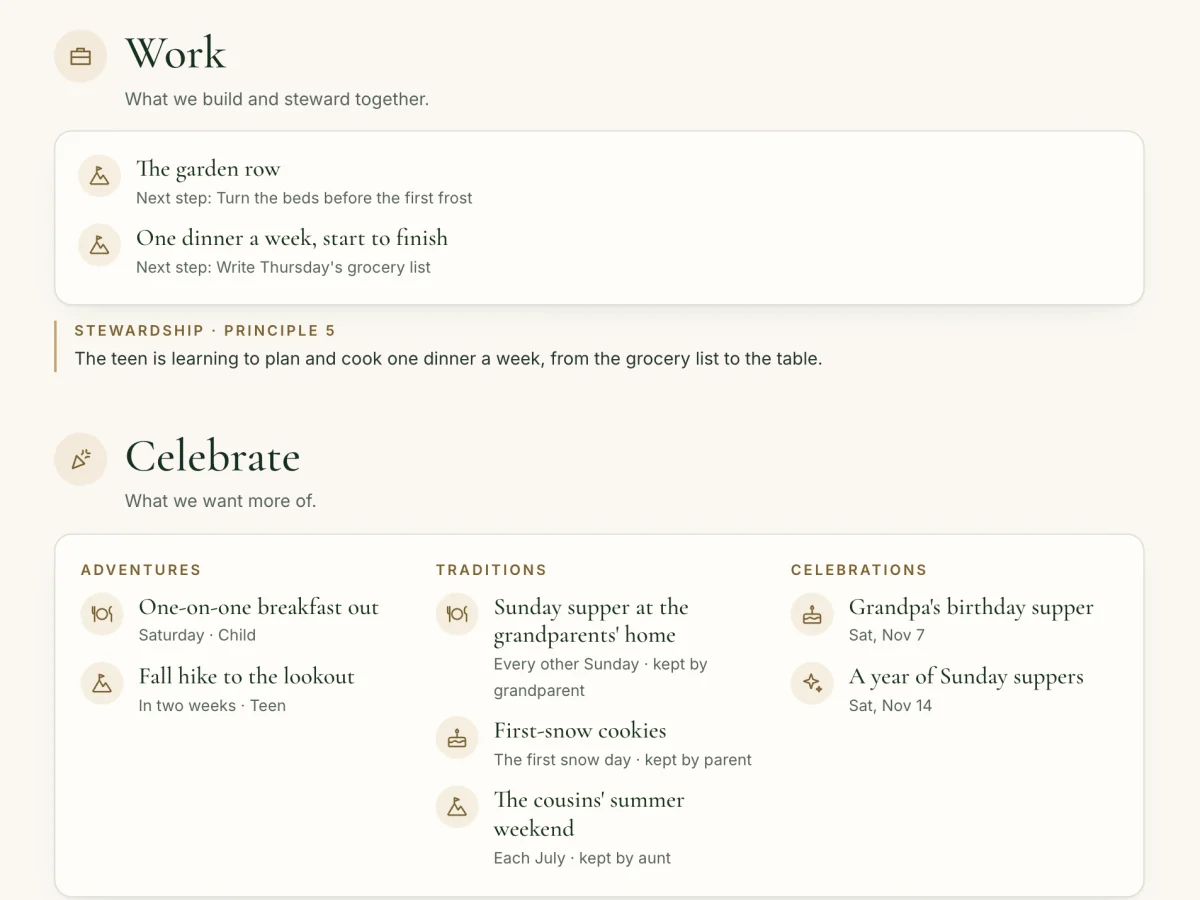
- Include older children. A teenager can own the pantry list or a weekly dinner. That lightens the load and teaches them to run a home.
Fair does not always mean equal. One partner may work longer hours outside the home. What matters is that both of you look at the whole picture and agree it feels right.
How do we keep it from sliding back?
Division drifts. The person who used to carry everything will notice the gaps first and be tempted to quietly fill them. The other may forget, then rely on reminders, and the old pattern returns.
A weekly planning sitting is the best guard. Once a week, perhaps Sunday evening, walk through the coming days together: what is coming, who is carrying what, and what you will enjoy. When the load is said out loud every week, it cannot hide. If one week looks heavy for one of you, you can see it and shift something.
Keep the plan where both of you can see it. A shared calendar or a list on the fridge means the household's memory lives outside one person's head. That alone lightens the load.
How do we talk about it without a fight?
This conversation can feel loaded, because underneath it are feelings about fairness and being seen. A few ways to make it easier:
- Choose a calm time. Not in the middle of a hard evening, when you are already resentful.
- Start with the work, not the person. "I want us to look at everything it takes to run our home" lands better than "You never notice anything."
- Say what it costs you. "I feel like I never get to stop thinking about the house" is honest and clear.
- Ask, and listen. Your partner may feel unappreciated for work you do not see either.
- Agree on one change at a time. Hand over one whole area this week. Add another next month.
If the conversation stalls or turns sharp, stop and come back to it. Small things stay small when they have a protected place to be said.