This is for parents of babies and young children who used to go out together and now can't, whether because of money, distance from family, a child who won't settle for anyone else, or plain exhaustion. It covers why the at-home date matters, how to set one up so it doesn't dissolve into laundry and screens, what to actually do, and how to keep it going through the hard weeks.
Why does a date at home count?
Because the point of a date was never the restaurant. It was the attention. Two people choosing each other on purpose, for an evening, with nothing else asking for them. A night out made that easy, because the setting did the work: someone else cooked, someone else cleared, and there was nowhere else to look.
At home the setting works against you. The dishes are in the sink, the toy bin is overflowing, and the phone is right there. So the at-home date needs a little more intention to give it the shape that a night out gave for nothing. That intention is the gift. When you build a date out of an ordinary evening, you are telling each other, "Even now, in this season, you still come first after the children."
Many couples in the young-children years quietly stop dating and tell themselves they will start again when things settle. Things rarely settle on their own. A weekly hour, kept on purpose, is how the marriage stays a friendship and not only a partnership for getting through the day. If you sense that has already started to slip, the essay on a weekly couple check-in pairs well with this one.
How do we set it up so it actually happens?
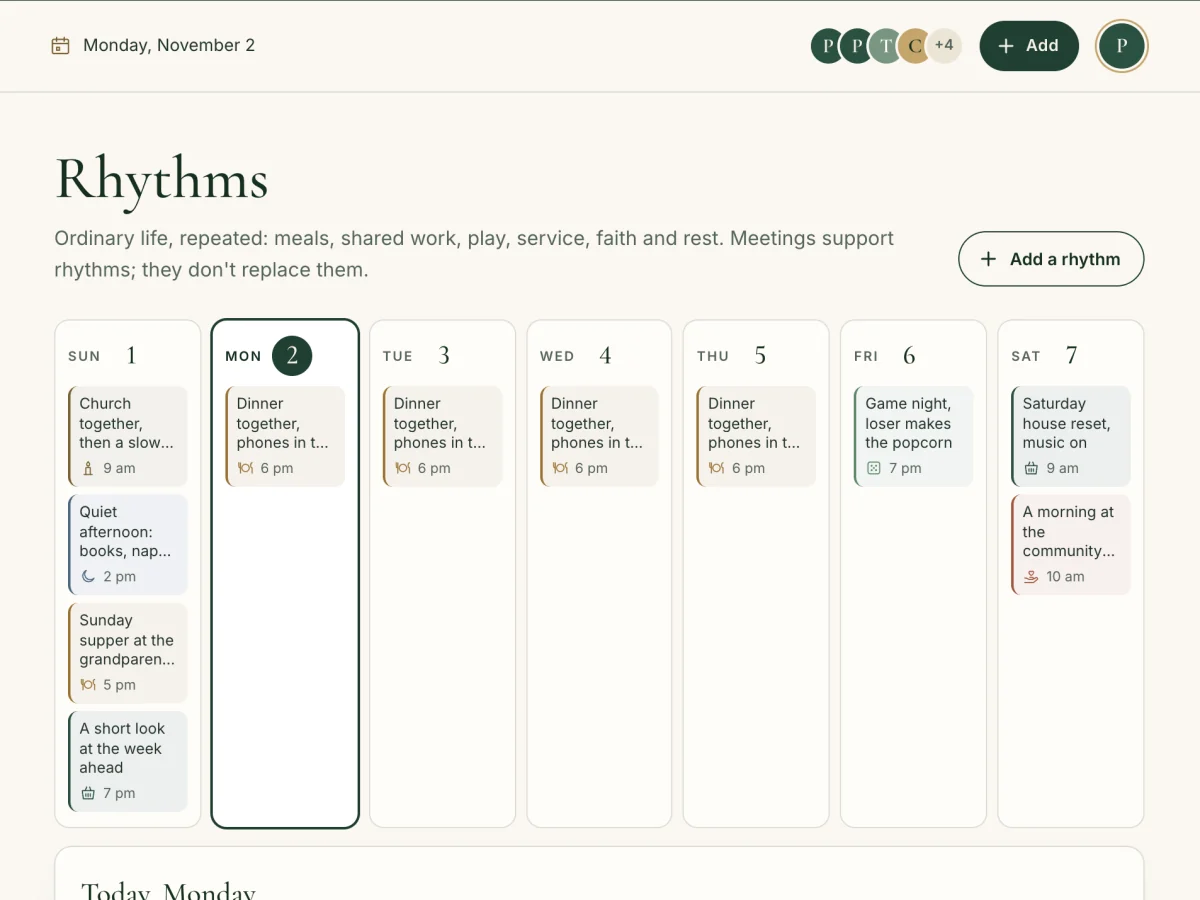
A date that depends on both of you feeling energetic will not survive a month. Make it a rhythm instead, so the decision is already made.
- Pick one night and keep it. The same evening every week, so neither of you has to suggest it. Choose a night with nothing early the next morning.
- Name a start time. "After the kids are down" drifts into ten o'clock. Say a time, and work the bedtime routine toward it.
- Clear one room. Not the whole house. Just the space where you will sit, cleared in five minutes, lamps on, the overhead light off.
- Move the phones. Into a drawer or another room. If you need a baby monitor, keep the monitor and nothing else.
- Decide what you will do earlier in the week. Planning on the night itself usually ends in scrolling through shows for forty minutes.
That last point matters most. A plan made in advance turns the evening from "what do you want to do" into "here's what we're doing," which is what a date feels like.
Repetition tells us who we are.
What do we actually do on a date at home?
Keep it simple, and let it feel different from a normal evening. A few ideas couples come back to:
- Cook something together after the children eat. A dish you would never make on a weeknight, or breakfast for dinner with good coffee.
- Order takeout and eat at the table with a candle. The candle is not silly. It marks the evening as set apart.
- Play a two-person game. Cards, a word game, a puzzle on the table. Games give you something to do with your hands while you talk.
- Ask each other real questions. What are you looking forward to this year? What did you love when you were twelve? What has been hard lately that I might have missed?
- Watch one thing you chose ahead of time. A film you both wanted to see, with no second screen, and ten minutes afterward to talk about it.
- Sit outside. A porch, a balcony, the back steps. A warm drink and the evening sky change the feel of the night.
- Revisit something from before the children. Old photos, the music from your wedding, a meal from an early trip.
Alternate who plans, so one person isn't always responsible for the evening. The planner keeps it simple and the other person agrees to show up for whatever it is.
What should we keep off the table?
The at-home date shares a room with the rest of family life, so it is easy for the rest of family life to walk in. Agree on a few gentle boundaries.
- No logistics. Calendars, schedules, who is picking up whom on Thursday. Those belong to another night.
- No heavy issues, unless both of you want it. If something needs talking through, name it and set another time. The date is for being together, not for working through the backlog.
- No chores. If the dishes are still in the sink at eight, they can wait until morning.
A father of two small children described the change simply: once he and his wife stopped talking about the week on date night, they started laughing again. The week still got planned, just not then.
What if one of us is too tired?
Some weeks you will be. A teething baby, a sick toddler, a long shift. On those nights, shrink the date instead of cancelling it. Twenty minutes on the couch with tea and no phones still counts. Saying "I'm exhausted, but I want to sit with you for a bit" keeps the rhythm alive and is honest about the week.
If a night is lost entirely, don't make it a matter of guilt. Pick the next evening that works, or simply wait for the same night next week. A rhythm survives missed weeks as long as you come back to it. What erodes it is quietly letting it go without saying so.
Notice, too, when tiredness becomes a pattern. If one of you is always too depleted to show up, that is worth gently naming. It may mean the load at home is uneven, and the essay on the mental load may help you talk about it.
How do we keep it from becoming another chore?
By letting it be enjoyable rather than correct. A date is not a task to tick off. If an idea isn't fun, drop it. If you both love the same simple evening every week, keep it. Some couples find their favorite date is the most ordinary one: toast, a puzzle, and an hour of talk.
It also helps to look back now and then. Every few months, ask each other which dates you liked best and what you would change. Small adjustments keep a rhythm feeling like yours instead of like an obligation. Over time, the weekly date at home becomes one of the things your marriage is built on: an hour that says, every week, we are still choosing each other.